
Top 10 Animals With the Strongest Bite Force in the World: Ranked by Power
In the animal world, speed, strength and smartness help species survive. For predators, one trait makes a big difference between being a good hunter and a bad one i.e., the bite.
When we look at the power ranking for Animals with the strongest bite force we must look first at the Saltwater crocodile. Its jaws are incredibly strong. Take the hyena whose teeth can crush bones. Nature has created some extraordinary ways for animals to bite with huge force. Some bites can create thousands of newtons of force. That kind of power lets them break bones, cut through muscle and grip their prey tightly. It’s a force to be reckoned with.
Saltwater crocodiles have the highest bite force ever measured in an animal Kingdom holding the world record for the most powerful bite force in a living animal. A big Saltwater crocodile can bite down with about 16,414 newtons of force according to a 2012 study.
Saltwater crocodiles are not the only animals with a strong jaw. Great white sharks, hippos, alligators, jaguars and spotted hyenas also have some of the strongest bites in the animal world.
Which animals have the strongest bites and How do scientists measure animals with the strongest bite force?
Lets look at the animals first.
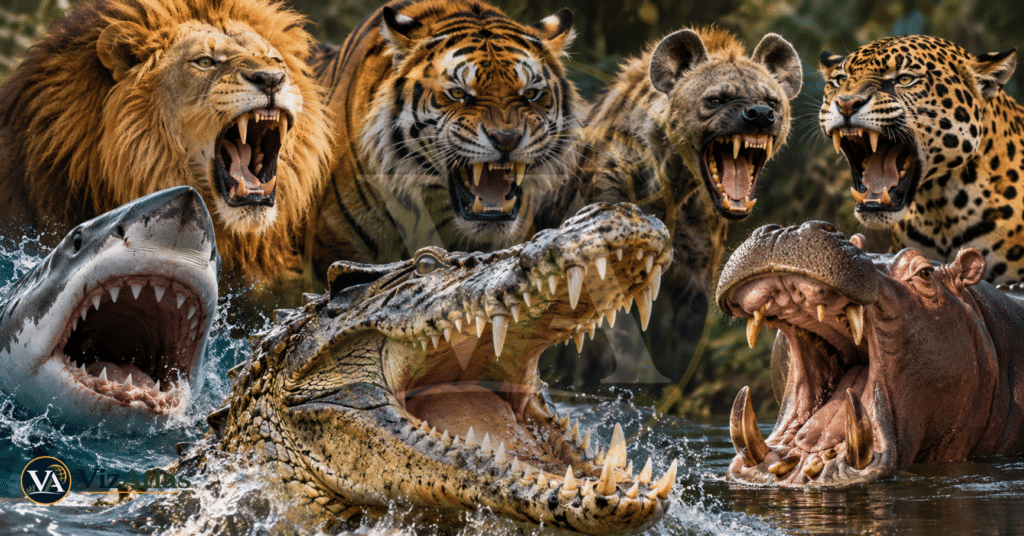
Animals with the Strongest Bite Force in the World
| Rank | Animal | Bite Force |
|---|---|---|
| 1 | Saltwater Crocodile | 16,414 N |
| 2 | Great White Shark | ~18,000 N |
| 3 | American Alligator | ~13,172 N |
| 4 | Hippopotamus | ~8,000 N |
| 5 | Mugger Crocodile | ~7,295 N |
| 6 | Orinoco Crocodile | ~6,276 N |
| 7 | Tiger | ~1,525 N |
| 8 | Lion | ~1,314 N |
| 9 | Jaguar | ~1,014 N |
| 10 | Spotted Hyena | ~773 N |
Understanding Bite Force: What Does It Actually Measure?
Bite force is the power an animal creates when it closes its jaws on something or catches prey.
It depends on:
- The size and strength of the jaw muscles.
- The Structure of the skull.
- Where the teeth are placed.
- The size of the body.
- Jaw mechanics and leverage.
- The animals eating habits from evolution.
An animal with a large head and very strong jaw muscles can create a lot of force. Being big isn’t the only thing that matters when it comes to bite force.
How Do Scientists Measure Animal Bite Force?
Direct Measurement
The team of Scientist placed a special force sensor between an animal’s jaws. They recorded the force the animal created when it bit down.
It provides numbers but this number can change depending on the size of the animal, how motivated the animal was and where the sensor was placed.
Computer modelling and skull analysis
If it is difficult or not safe to measure an animal’s bite force then scientists can guess the bite force by looking at skull measurements, how the jaw muscles operate and using computer models.
This is interesting but Not as good and accurate as if they had actually measured the bite force.
A difference that matters for instance when sharks, large mammals and crocodilians are compared.
Top 10 Animals With the Strongest Bite Force in Nature
Saltwater Crocodile – The Strongest Measured Bite in the Animal Kingdom
Scientific Name: Crocodylus porosus
Recorded Bite Force: 16,414 N
Measurement: Directly measured
Saltwater crocodile has the strongest force of bite ever measured in a living animal.
From areas of Southeast Asia to Australia and the surrounding areas, this monstrous reptile is truly one of the most deadly creatures on Earth. A large wide jaw with teeth and mouth muscles enable it to bite powerfully.
In the major study on the subject which was published in the journal PLOS ONE in 2012, the scientists examined the bite force of living crocodilians. In one saltwater crocodile, 4.59 m in length, the researchers recorded a bite force of 16,414 N (approximately 3,689 lbf).
Great White Shark – A Powerful Bite Hidden Beneath the Ocean
Scientific Name: Carcharodon carcharias
Bite Force: Approximately 18,000 N
Measurement: Computer-model estimate
If you ever want to see what a shark bite looks like, you can see the white shark.
With dozens of triangular serrated teeth, it takes jaws to bite into flesh. They Slice rather than grip as crocodiles tend to do.
Research has also suggested that huge great white sharks may produce bite forces of 18,000 N.
Yet this number is just a modelling estimate, not a reading taken from a living great white shark. So you can’t really count this as a record, above the saltwater crocodile.
Subscribe to our $1 newsletter to get new Data and Maps from around the world on various different topics every month. Click here now to join.
American Alligator – One of the Strongest Bites Ever Recorded
Scientific Name: Alligator mississippiensis
Recorded Bite Force: Up to approximately 13,172 N
Measurement: Directly measured
Another fascinating example of a crocodilian strength of the jaw is that of an American alligator. This animal is native to the southeastern United States and the surrounding area. It lives in freshwater rivers, lakes, wetlands and swamps.
The large skull and thick jaw muscles are also the reason this animal has a huge bite force.
According to a 2012 study on bite force, an American alligator has a bite force measured at around 13,172 N.
Hippopotamus – The Powerful Bite of a Giant Herbivore
Scientific Name: Hippopotamus amphibius
Commonly Quoted Bite Force: Approximately 8,000 N
Measurement: Commonly reported estimate; not a standardised direct measurement
The hippopotamus is perhaps the unlikely of all the entries when thinking about powerful animal bites. Even though it mainly eats plants, this animal has a massive mouth, enormous jaw muscles and very large canine and incisor teeth.
Hippos spend most of their time in rivers and lakes. They come onto land only to eat. Their mouths can open wide, showing enormous teeth that can cause terrible injuries.
Mugger Crocodile – A Powerful Predator of South Asia
Scientific Name: Crocodylus palustris
Recorded Bite Force: Approximately 7,295 N
Measurement: Directly measured
The mugger crocodile also called Indian crocodile is native to the Indian subcontinent. This species lives in freshwater including lakes, rivers and ponds.
The mugger crocodile has a broad snout and a powerful body – a highly efficient hunting machine. It feed mostly on fish, amphibians, reptiles, birds and mammals.
In the 2012 research on crocodilian bite forces, the mugger crocodile produced a force of about 7,295 N.
Orinoco Crocodile – A Rare Giant With Powerful Jaws
Scientific Name: Crocodylus intermedius
Recorded Bite Force: Approximately 6,276 N
Measurement: Directly measured
The Orinoco crocodile is one of the largest crocodilian species. Derived from the Orinoco River basin in Venezuela and Colombia.
Unlike the saltwater crocodile, the Orinoco crocodile has a more limited distribution and is critically endangered. It has a robust body and a proportionally narrow snout as it mainly feeds on aquatic prey.
In 2012, one of the specimens measured the bite force to be approximately 6,276 N.
Spotted Hyena – The Bone-Crushing Specialist
Scientific Name: Crocuta crocuta
Estimated Canine Bite Force: Approximately 773 N
Measurement: Skull-based biomechanical estimate
Spotted hyena is the most successful carnivore in Africa. Spotted hyena is known for its strong jaw and for using its mouth to eat parts of carcasses that many other predators leave behind.
Spotted hyena has specialised teeth and a jaw structure that crush bones so it can reach the nutritious marrow inside.
The bite force of the canine teeth of a spotted hyena was measured in a 2005 paper published in the Proceedings of the Royal Society B and found to be about 773 Newtons.
Tiger – A Powerful Bite Built for Large Prey
Scientific Name: Panthera tigris
Estimated Canine Bite Force: Approximately 1,525 N
Measurement: Skull-based biomechanical estimate
Tiger is the largest living member of the cat family and one of the strongest land predators. Tiger’s size and strength are both impressive.
Tiger is a master of the hunt thanks to its neck, strong limbs and strong teeth. Tiger uses every part of its body to capture prey.
Typically Tiger hunts deer, wild boar and other medium to large prey. Tiger stalk the prey silently through the forest.
Stephen Wroe and others 2005 study, conducted in this context put the projected canine bite force of Tiger at 1,525 N.
Jaguar – The Strongest Bite Relative to Body Size Among Big Cats
Scientific Name: Panthera onca
Estimated Canine Bite Force: Approximately 1,014 N
Measurement: Skull-based biomechanical estimate
The jaguar is a native of the Americas. The jaguar is most famous for its jaws. Even though the jaguar is usually smaller than a tiger or a lion, it has a thick skull for such a small body.
Jaguars are different from other big cats because they can deliver a very strong bite straight to the skull of their prey.
A 2005 study comparing mammals found that the bite force of a jaguar’s canines is 1,014 N.
Lion – Powerful Jaws Designed for Cooperative Hunting
Scientific Name: Panthera leo
Estimated Canine Bite Force: Approximately 1,314 N
Measurement: Skull-based biomechanical estimate
The lion is one of the world’s most recognisable predators. Lions hunt together as a pride while tigers and jaguars usually hunt alone.
A lion has powerful jaw muscles and very sharp canine teeth that help the lion trap and choke its prey. The lion’s prey include zebra, wildebeest and buffalo.
The 2005 Wroe research study estimated that the lion’s bite force at the tip of lion’s canine tooth is 1,314 N.
Conclusion: Which Animal Has the Strongest Bite in Nature?
The saltwater crocodile is the animal with the highest bite force ever measured in a living animal with a powerful force of 16,414 N recorded in an experiment.
The other strong Contender is the great white shark and computer models have shown that some of the underwater animals might have even more force. Those guesses have not yet been proven by real measurements though.
American alligators, hippopotamuses, mugger crocodile and Orinoco crocodiles also have amazingly huge teeth.
Saber toothed cats, hyenas, jaguars, tigers and lions are mammals that have jaws that help them catch prey, break bone and survive in competitive environments.
The coolest thing we have learned is that there is not one perfect bite. Some animals developed jaws to pound on bones, others developed jaws to grab onto writhing prey and still others developed jaws to tear flesh apart with their little teeth.
Nature does not make the strongest jaws to win. Nature makes the strongest jaws to survive.
Subscribe to our $1 newsletter to get new Data and Maps from around the world on various different topics every month. Click here now to join.
Sources
- Erickson et al. (2012): https://doi.org/10.1371/journal.pone.0031781
- Wroe et al. (2005): https://doi.org/10.1098/rspb.2004.2986
- Guinness World Records: https://www.guinnessworldrecords.com/world-records/401566-strongest-molariform-bite-force-for-a-crocodile
- Live Science: https://www.livescience.com/which-animals-have-the-strongest-bite