Most Militarized Countries in the World 2026: Global Rankings
A nation doesn’t need the biggest army in the world to be highly militarized. It can be measured by how the economy depends on the military. It can be the number of people serving in the uniform, the size of reserve forces or how many heavy weapons exist compared to the population.
This kind of difference shows a way of thinking about military power. A country with an huge economy can spend a lot of money on defense without it taking up a big slice of its overall resources. A smaller country might spend less in total but still use a large share of what it has. Both can be powerful militarily. They are militarized in different ways.
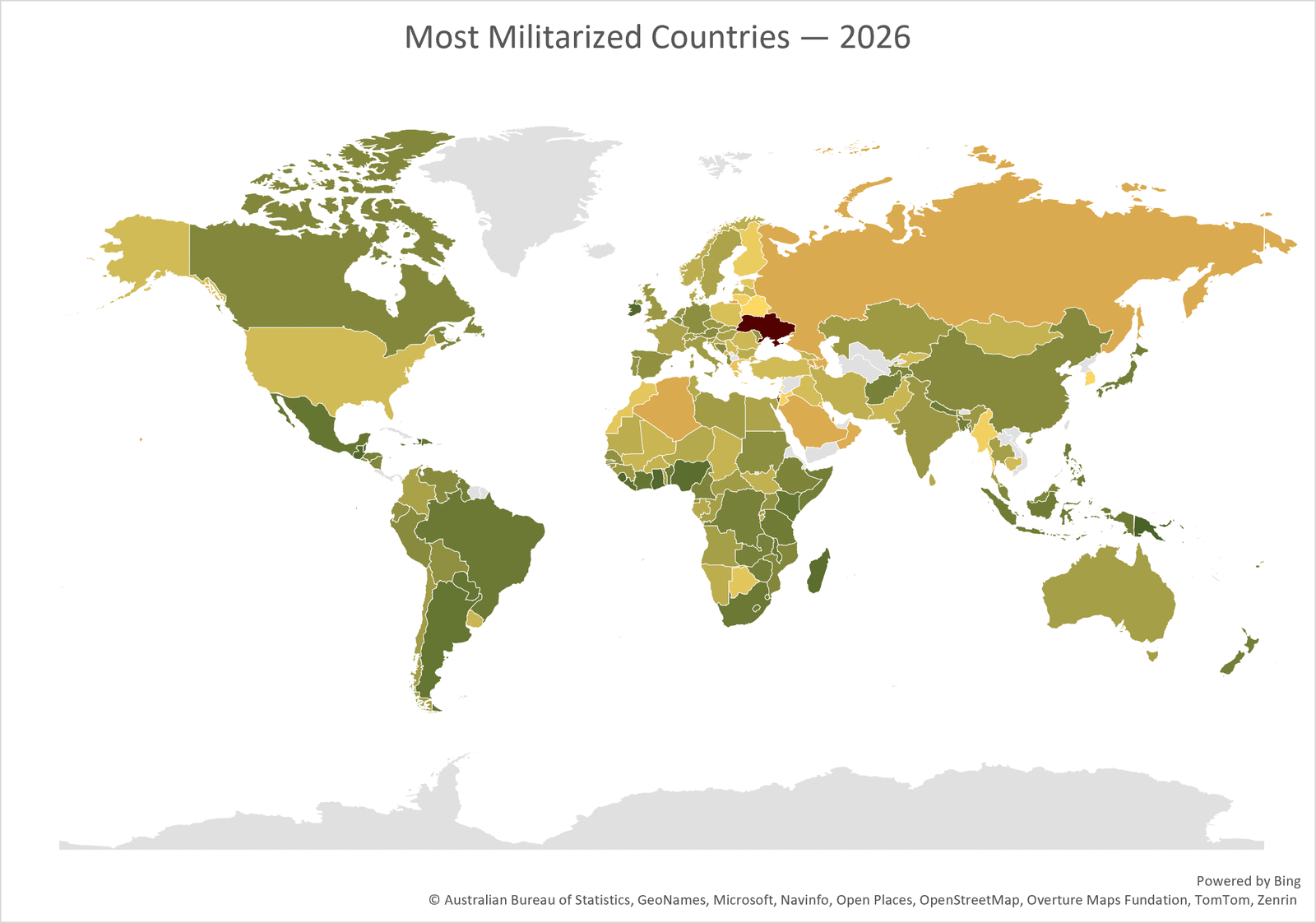
The VizAtlas‘s Militarized Countries Ranking for 2026 looks at this, using data from 151 countries.
The top of the list stands out. The very top is crowded with many countries. The middle has countries at varying levels of involvement. The bottom is long but slightly skewed toward the left. The highest score is 338. The lowest is 19. The average is 107.26. The median is 98.
These numbers show a world where military resources are spread out unevenly across population, economy and civilian needs.
The real question is more interesting than the top score: How exactly can a nation become overly militarized— Why does it matter?
What Is Militarization?
Militarization means how much a country’s military is present in its society. It is not the same as having huge military power, spending a lot on the military or being able to win wars.
A militarized society uses a part of its people, time and resources for military needs. This includes soldiers, paramilitary groups, reserves, weapons and money spent on defense.
It’s important to understand the difference. A large army doesn’t always mean it is a Militarized nation. For example a country with one million people having an army of 100,000 has a bigger military presence than a country with 100 million people and the same army size. Similarly spending billion on defense may be a huge strain for a small economy but not for a large one.
The Global Military Expenditure Index or GMI was created by the Bonn International Centre for Conflict Studies. It measures how big a country’s military is compared to its Civilians. It looks at spending, the number of soldiers and heavy weapons. Then it compares these to things like income, health spending and population.
So the best way to see the GMI is as a ranking of how military presence each society has. It does not measure how strong a country’s military is in simple terms.
Which Countries Are the Most Militarized in the World in 2026?
| Rank | Country | Militarisation Score |
|---|---|---|
| 1 | Ukraine | 338 |
| 2 | Israel | 275 |
| 3 | Qatar | 234 |
| 4 | Armenia | 220 |
| 5 | Russia | 213 |
| 6 | Algeria | 213 |
| 7 | Saudi Arabia | 212 |
| 8 | Brunei | 210 |
| 9 | Oman | 210 |
| 10 | Azerbaijan | 209 |
| 11 | Kuwait | 204 |
| 12 | Bahrain | 204 |
| 13 | Singapore | 197 |
| 14 | Greece | 196 |
| 15 | Jordan | 186 |
| 16 | Lebanon | 183 |
| 17 | Belarus | 177 |
| 18 | South Korea | 174 |
| 19 | Myanmar | 167 |
| 20 | Lithuania | 167 |
| 21 | Cyprus | 163 |
| 22 | Finland | 162 |
| 23 | Morocco | 157 |
| 24 | Estonia | 155 |
| 25 | Botswana | 155 |
| 26 | Poland | 148 |
| 27 | Iraq | 144 |
| 28 | Türkiye | 142 |
| 29 | United States | 142 |
| 30 | Kyrgyzstan | 142 |
| 31 | Serbia | 142 |
| 32 | Cambodia | 142 |
| 33 | Romania | 138 |
| 34 | Uruguay | 136 |
| 35 | Pakistan | 135 |
| 36 | Mali | 135 |
| 37 | Latvia | 134 |
| 38 | Chad | 133 |
| 39 | Georgia | 132 |
| 40 | Montenegro | 132 |
| 41 | Burkina Faso | 132 |
| 42 | Mongolia | 132 |
| 43 | South Sudan | 129 |
| 44 | Iran | 127 |
| 45 | Namibia | 125 |
| 46 | Norway | 125 |
| 47 | Mauritania | 124 |
| 48 | Burundi | 123 |
| 49 | Bulgaria | 122 |
| 50 | Croatia | 121 |
| 51 | Tunisia | 120 |
| 52 | Denmark | 119 |
| 53 | Niger | 119 |
| 54 | Sri Lanka | 119 |
| 55 | Gabon | 119 |
| 56 | Egypt | 113 |
| 57 | France | 112 |
| 58 | Sweden | 112 |
| 59 | Colombia | 110 |
| 60 | Hungary | 110 |
| 61 | Togo | 108 |
| 62 | Australia | 107 |
| 63 | Angola | 107 |
| 64 | Thailand | 107 |
| 65 | Republic of the Congo | 106 |
| 66 | Slovakia | 105 |
| 67 | Libya | 104 |
| 68 | Chile | 103 |
| 69 | Italy | 103 |
| 70 | Central African Republic | 102 |
| 71 | Slovenia | 102 |
| 72 | Switzerland | 102 |
| 73 | Kazakhstan | 101 |
| 74 | Guinea | 100 |
| 75 | United Kingdom | 98 |
| 76 | India | 98 |
| 77 | Rwanda | 97 |
| 78 | Czechia | 97 |
| 79 | Uganda | 94 |
| 80 | Guinea-Bissau | 93 |
| 81 | Portugal | 92 |
| 82 | Netherlands | 92 |
| 83 | Luxembourg | 91 |
| 84 | Moldova | 91 |
| 85 | Equatorial Guinea | 91 |
| 86 | Senegal | 91 |
| 87 | Ecuador | 90 |
| 88 | Spain | 90 |
| 89 | Bolivia | 89 |
| 90 | Albania | 89 |
| 91 | El Salvador | 89 |
| 92 | Germany | 88 |
| 93 | Sudan | 87 |
| 94 | Peru | 84 |
| 95 | Austria | 83 |
| 96 | Venezuela | 83 |
| 97 | China | 82 |
| 98 | Belgium | 81 |
| 99 | Bosnia and Herzegovina | 81 |
| 100 | Mozambique | 79 |
| 101 | Canada | 78 |
| 102 | Nicaragua | 78 |
| 103 | Malaysia | 77 |
| 104 | Fiji | 77 |
| 105 | Tajikistan | 75 |
| 106 | Cameroon | 75 |
| 107 | Ethiopia | 74 |
| 108 | Democratic Republic of the Congo | 71 |
| 109 | Afghanistan | 71 |
| 110 | Honduras | 70 |
| 111 | Zambia | 70 |
| 112 | Timor-Leste | 70 |
| 113 | Zimbabwe | 68 |
| 114 | New Zealand | 68 |
| 115 | Japan | 68 |
| 116 | Guyana | 67 |
| 117 | Somalia | 67 |
| 118 | Bangladesh | 67 |
| 119 | Eswatini | 66 |
| 120 | Indonesia | 65 |
| 121 | Jamaica | 65 |
| 122 | Tanzania | 65 |
| 123 | Philippines | 65 |
| 124 | Nepal | 64 |
| 125 | Brazil | 61 |
| 126 | Lesotho | 60 |
| 127 | Malawi | 60 |
| 128 | Benin | 60 |
| 129 | South Africa | 60 |
| 130 | Kenya | 57 |
| 131 | Côte d’Ivoire | 57 |
| 132 | Mexico | 57 |
| 133 | Gambia | 56 |
| 134 | Paraguay | 56 |
| 135 | Dominican Republic | 55 |
| 136 | Argentina | 55 |
| 137 | Nigeria | 48 |
| 138 | Seychelles | 47 |
| 139 | Madagascar | 47 |
| 140 | Liberia | 46 |
| 141 | Belize | 44 |
| 142 | Ghana | 40 |
| 143 | Ireland | 40 |
| 144 | Sierra Leone | 40 |
| 145 | Guatemala | 38 |
| 146 | Trinidad and Tobago | 38 |
| 147 | Cabo Verde | 37 |
| 148 | Mauritius | 33 |
| 149 | Papua New Guinea | 32 |
| 150 | Malta | 24 |
| 151 | Haiti | 19 |
Military Spending: The Financial Weight of Defense
Military expenditure of the militarized country is the most basic sign of how militarized a country is. Military expenditure shows how much society moves socially and economically to support the military.
That is only one part of the whole picture.
The real question is whether military expenditure is matched by the country’s Economic output and by government priorities.
The GMI method looks at expenditure as a share of gross domestic product and health expenditure. These measures get a huge score because they show how important defense is in a country’s total resource use.
This makes a important difference between the size of the military and the military burden on the nation.
A large economy can fund a defense budget and still give only a small part of its total output to defense. A small economy might spend little amount in total but that amount could be a large part of what it has available for defense.
Neither number alone tells the whole story. Absolute military expenditure tells us how much money is spent on the military. Relative military expenditure tells us how important that spending is to the nation’s economy overall.
These two figures cannot be swapped because they ask different questions.
Subscribe to our $1 newsletter to get new Data and Maps from around the world on various different topics every month. Click here now to join.
Personnel: How Much of Society Is Connected to the Military?
The second main point concerns the military and paramilitary personnel.
The population served by forces is as important as the number of people in armed forces.
When a tiny country has a large military personnel force, then that force becomes a major part of society. In a big nation, the same number of soldiers would represent only a small fraction of the population.
Reserve forces add another dimension.
A state can maintain an active military and recruit many trained personnel who can be called upon during emergencies. Looking at a state’s active numbers however would miss the full size of that state’s military force capabilities.
The GMI therefore evaluates the strength of forces and paramilitary personnel relative to the population, the strength of reserve forces relative to the population and the ratio of military personnel to physicians.
These differences show how the military plays a role in society.
They also show how a picture of a country’s militarization cannot be drawn from the size of its armed force shown in the media, the number of soldiers seen in parades or the size of the headlines used when talking about its armies.
The question we must ask is how large that military presence is relative to the society it exists in.
Heavy Weapons: Measuring the Military Footprint
The Weapons that an armed service has available must always be considered with the personnel and spending.
The GMI methodology looks at categories of heavy weapons in relation to the population. For example it includes Defected armored vehicles, artillery that exceeds certain caliber thresholds, combat aircraft and large fighting ships.
The main focus is on selected systems of the military not on all equipment. This is important because large weaponry can be expensive to buy and run and a high concentration can signal huge military assets. But Equipment counts have limits.
A large stockpile does not mean the systems are all up and running, modern and well maintained and can be moved where they are needed. Counting the equipment in storage does not give a picture of training, supply, ammunition stocks, command systems and experienced operators. The way these elements combine determines the size of a force.
Hence the heavy weapons component must be seen as one of the important part of a measurement not as the total of combat effectiveness.
The Big Pattern
Militarization Is About Priorities as Much as Power
The main idea behind the rankings is that militarization measures how much a country prioritizes power. Because of this, there’s some artificiality in ranking countries by their military strength.
A country with an big economy, advanced technology, big industrial base and global responsibilities can have a powerful military. These same factors also contribute to a high militarization score.
Some states may be ranked higher if they spend a larger part of their economic resources on defense or if they have a large number of military personnel and equipment even in a small country. That’s why the top of the list doesn’t always match up with the defense budgets in the world.
These differences help explain why militarization can rise quickly during times of crisis or insecurity. Governments can increase spending, expand their forces or activate reserves and equipment. This makes the military more visible and influential in society.
Another reason is that some countries facing insecurity may not have the money, institutions or capacity to grow their militaries.
The May 2026 GMI 2025 report states that conflict can exist without militarization. So militarization doesn’t automatically mean there is a conflict. In short, the link between pressure and military power is not simple. They are connected but not the same thing.
Why Small Countries Can Rank Above Large Military Powers
It might seem odd. The smallest countries often show up high in rankings for relative militarization. The reason is simple. Many of the indicators used to measure militarization include population and economy as part of the denominator. So even a small military force can look very large when compared to a population. Likewise a modest amount spent on defense might seem small on the world financial stage. When the economy is tiny that spending becomes a big share of the total.
A larger country could spend more in actual dollars and have more soldiers but still rank lower. That happens because the numbers are spread over a bigger population and a larger economy. So the impact per person or per dollar is less. This doesn’t mean the smaller country has a large military. It just means the military takes up huge space in society when the index is built this way.
The rankings for militarization don’t always reflect military strength. They reflect how heavy the military is relative to the size of the country.
That’s something to keep in mind when comparing rankings based on militarization, with those based on power or capability.
Conclusion: Militarization Is More Than Military Size
In the Militarized Countries Ranking 2026, We see a world where the role of the military shifts in importance from one nation to another.
Out of 151 countries ranked, the scores range from 19 to 338. The average score is 107.26, the middle value is 98. The average of the top 10 countries is 233.4. The average of the bottom 10 is 34.1.
These numbers show how different countries choose to distribute their resources—between people and soldiers & between growth and weapons.
The most important idea here is not about the numbers but It’s about understanding what militarization actually means.
Militarization is not the same as strength. Militarization is not the same as peace. Militarization is not the same as security.
One country might have the huge army in terms of how much money it spends but that doesn’t mean it is the most militarized. Another country might have a small military but that military takes up a much larger share of its economy and daily life. That’s the difference.
The ranking helps show this gap.
It pushes us to think about how we define security. Yes, military spending matters. Yes, the number of troops matters. Yes, the size of weapons matters. Only when these are tied to the society that supports them and the real problems they are meant to solve.
In the end, the militarization index doesn’t tell us who would win a war. It reveals that how much of society is shaped by the military, How much of life is influenced by the presence of soldiers, weapons and national defense.
Compared to the narrow picture of military power, this may seem like a small point but in a world where others look at defense interests and global power, this detail matters a deal.
Subscribe to our $1 newsletter to get new Data and Maps from around the world on various different topics every month. Click here now to join.
Sources and Methodology
Original source: BICC Global Militarization Index 2026. Ranking Table
Recent report: The Global Militarization Index 2025. BICC
Metric: Global Militarization Index (GMI) score.
GMI measures how strong the military of a country is compared to its people and its economy. To create this measurement the study looks at three things:
- Money spent on the military compared to the country’s economy and government resources.
- Military: Number of people in the forces and similar groups compared to the total population.
- Heavy weaponry: How strong military equipment a country has compared to its population or other standards, for that country.