Rare Earth Reserves by Country 2025–2026: Top Countries Ranked by Critical Mineral Wealth
A smartphone, a motor, a wind turbine, a missile guidance system and a modern data centre – they all look very different.
They seem to have nothing in common but Looks can be deceiving and there is an important common factor: Rare Earth Minerals.
These 17 items have a special place in the world economy. They are not necessarily rare in the Earths crust. The places where they can be mined profitably are very uncommon and mining them and turning them into useful goods requires heavy industry.
This makes these reserves more than a geological fact.
Rare earth minerals act as a sign of future mineral supply and rare earth minerals are now becoming more and more important in the global technology, energy and manufacturing sectors.
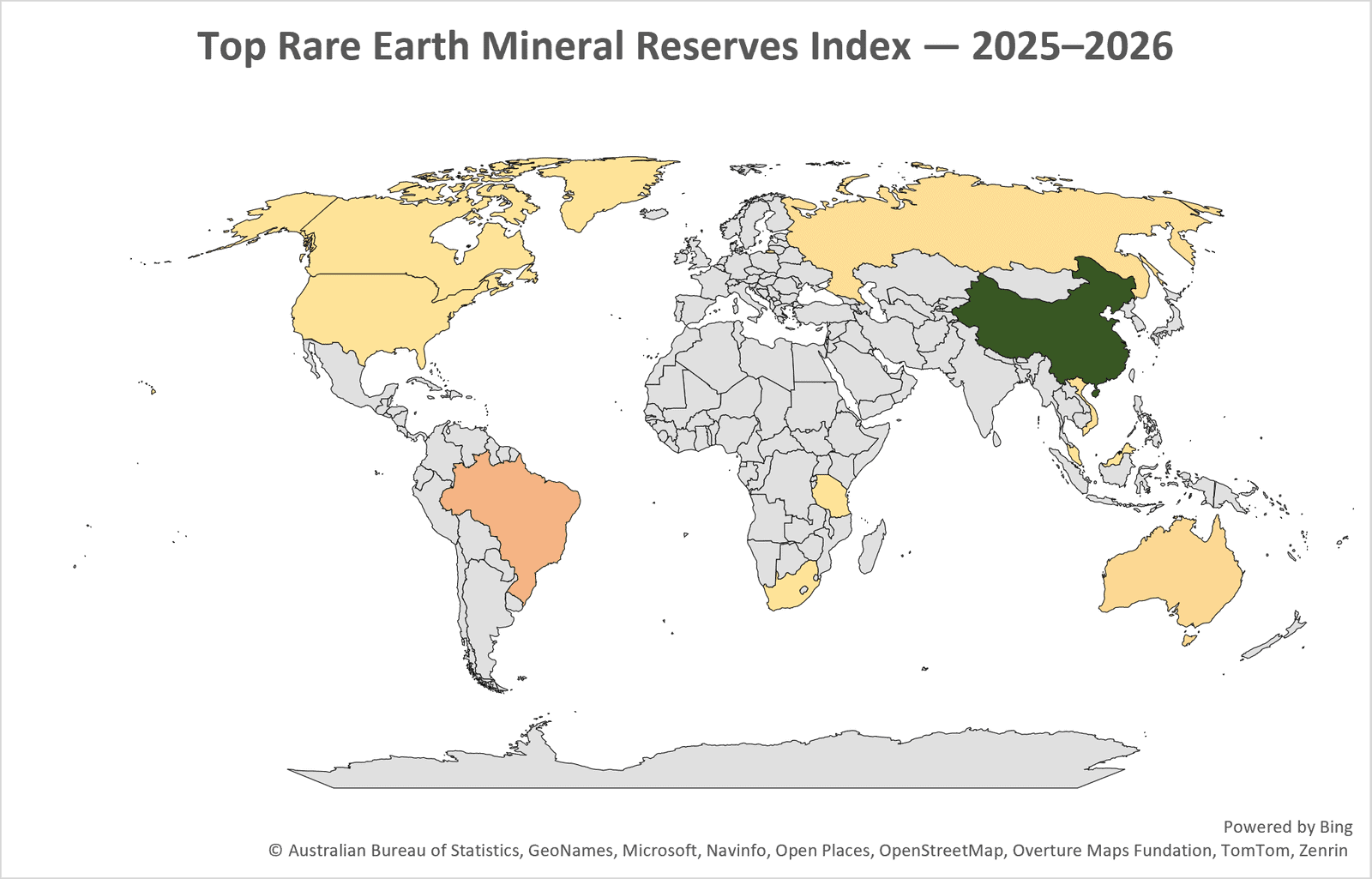
The Top Rare Earth Mineral Reserves Index 2025-2026 which lists 11 countries and territories with a reserve base of, about 85.29 million tonnes, This index is dominated by one country. That single country accounts for 51.6% of all reserves while the top three together account for 83.6%.
The economic reserve base of these resources as shown in this index is not evenly spread across the world.
That matters because rare earth minerals are increasingly found in the products that make up the modern economy.
What Are Rare Earth Elements?
The term “rare earths” can be misleading.
What are rare earths? The 17 rare earth elements (REEs) are a group of metals. This group includes the 15 lanthanides, plus scandium and yttrium. According to the International Energy Agency four elements—neodymium, praseodymium, dysprosium and terbium—are especially important for clean-energy technologies and permanent magnets. They are used in a wide range of technology.
Others have uses in electronics, optical devices, catalysts, laser technology, communications gear, defence and also create strong permanent magnets. These magnets are key for generating electricity through wind turbines and electric motors.
The bottom line is that they are not one commodity. Each element is different. They vary in how they occur in nature their chemistry, costs, uses and risks in the supply chain.
Having a total rare earth reserve value does not mean that every rare earth element is found in large amounts in that nation.
That’s when the difference between the elements becomes more and more important, as technology changes.
What Does “Reserves” Actually Mean?
The word “Reserves” deserves attention. A reserve isn’t everything that you can get in undergrounds.
Mineral Reserves and Mineral Resources – the U.S. Geological Survey classifies mineral resources into reserves and resources. Reserves are the part of identified resources which can be mined or produced profitably and economically under conditions and requirements. That means a reserve estimate can change.
It can grow due to geological discoveries.
Exploration can refine estimates.
Higher prices make unprofitable deposits profitable.
New technology can recover resources that were previously unrecoverable.
Conversely, It can decline as well because of the impact of mining, economics or new geological data.
That is why a table of reserves is not a scoreboard of geologies for the future.
It should be viewed as an inventory of mineral potential of economic interest known today.
The 2026 U.S. Geological Survey Mineral Commodity Summaries was released in September. It estimates world- known rare-earth reserves at more than 85 million tonnes, generally consistent with the 85.29 million tonnes shown in the VizAtlas index.
| Rank | Country / Territory | Rare Earth Reserves (tonnes) |
|---|---|---|
| 1 | China | 44,000,000 |
| 2 | Brazil | 21,000,000 |
| 3 | Australia | 6,300,000 |
| 4 | Russia | 3,800,000 |
| 5 | Vietnam | 3,500,000 |
| 6 | United States | 1,900,000 |
| 7 | Greenland | 1,500,000 |
| 8 | Tanzania | 890,000 |
| 9 | South Africa | 860,000 |
| 10 | Canada | 830,000 |
| 11 | Malaysia | 710,000 |
Reserves Are Not Production
This is where rare earth statistics become interesting.
A country can have large reserves of rare earth and very small current mine production of rare earth. Another country can produce quantities of rare earth when it has a formally announced reserve base that is relatively very small.
That is because mining of rare earth is about much more than geology.
Capital is required for earth mining.
Infrastructure is required for earth mining.
Processing technology is required for earth.
Permitting and environmental management are required for earth mining.
Transport networks are required for earth.
Skilled labour and chemical‑processing expertise are required for earth.
Critically a viable market for rare earth must exist.
This discrepancy is evident in the 2026 USGS report. Mine production of earths was about 390,000 tonnes globally in 2025 while reserves of rare earth were more than 85 million tonnes.
In other words, very large amounts of rare earth could remain unextracted each year. So, a reserve of rare earth might be better understood as prospective rather than as an annual supply of rare earth.
It is important for you to keep this in mind while you are reading the map of rare earth.
The Geological Wealth Is Only the First Layer
Imagine finding a rare-earth deposit. It does not suddenly create a rare-earth industry.
The ore needs to be taken out. Then it usually has to be crushed and made concentrated. After that comes treatment and separation where these different minerals are taken apart from each other. The separated materials can then be turned into metals mixed into alloys and used in things like magnets.
The whole chain is included according to IEA from extraction and processing through separation, refining, mixing and the creation of the magnets.
Each step brings technical difficulties. This is where the global rare-earth story becomes much more complicated, than the reserves map would make you believe.
The Big Pattern: Reserves and Supply Chains Are Different Maps
The main point about the rare earth market is that rare earths are not all the same; rare earths differ between geological deposits and industrial use.
A reserves map shows how close rare earth material is to the surface. A supply-chain map reveals where rare earth material is extracted, processed, refined and turned into components.
Those maps can look very different.
The IEA estimates that in 2024, the dominant processing country handled 60% of global mined magnet rare earth production, roughly 91% of its refined production and 94% of its permanent magnet production.
That shows a range of variation, from having reserves to controlling the whole industrial chain.
Mining is the beginning of the rare earth journey. Most of the time, the important strategic bottlenecks happen higher up the chain.
That is why a country can lead in reserves but not become the world’s largest producer of finished rare earths. The ore must move down the chain to become rare earth. Every link matters in the rare earth process.
Why Rare Earths Matter to the Energy Transition
Rare earths have become very important because more and more things are becoming electric.
Rare earth magnets offer a high magnetic power for their relatively smaller size, which is why these materials are used in electric motors and generators.
Some of these materials are used in electric vehicle, motor designs and even in wind turbines in permanent-magnet systems.
The 2025 IEA rare-earth outlook says that the demand for magnet made from rare earths will keep growing as clean energy projects increase. In the IEAs stated-policies case, the demand for the magnet rare earths neodymium, praseodymium, dysprosium and terbium is expected to go from about 91 kt in 2024 to 123 kt in 2030 and 150 kt, in 2040.
That is a huge rise. But that is not the whole story. In addition, rare earths are also used in electronic devices, military equipment, aerospace technology, telecom equipment and machine tools.
The Technology Behind the Numbers
Rare earths are often called “critical minerals ” but criticality is not necessarily a measure of scarcity.
A mineral may be designated as critical because of:
economic importance
limited substitutes
concentrated production
difficult processing
long project-development timelines
and vulnerability to trade or geopolitical disruption.
The 2025 U.S. Critical-minerals list has 60 minerals on it including 15 rare earths. USGS had rare earths listed among minerals with very high supply-chain risk.
This is the reason for the importance of rare earth deposits, for the economy. The concern is not simply: “Do rare earths exist?”
It is:
Will the world be able to find and process these minerals and will the countries will be able to extract, manufacture and produce huge quantities of them consistently and cost effectively?
Why Processing May Matter More Than Mining
Mining is given the most attention because it is simple to think about. A mine makes tonnes. A reserve estimate has millions of tonnes.
The hardest and most tricky part might be after the material is taken out of the ground.
Refining rare earth metals even though there are problems with politics also the process is quite hard to do. When you are looking for any study we could only suggest.
According to the IEA, separating the metals is the “heart of the entire rare-earth processing chain.”
This is one reason why having the ability to process may be more important than having a lot of the material.
A big reserve without the tools to process it, may just stay as something found in the ground.
A complicated system for processing can take a large amount of raw material and make lots of product. This is the reason that the “mine-to-magnet” chain has become the focus of the conversation, about rare earth security.
The 2025–2026 Supply-Chain Wake-Up Call
Recent events have shown why this matters. In 2025, export restrictions on heavy rare earths and their derivatives caused disruptions in industries outside the main processing areas. The IEA reported that some automakers had trouble getting magnets. As a result some manufacturers had to reduce output or stop production for periods.
This situation revealed something very important. A supply disruption does not have to come from a shortage of an amount of material.
Even a ban on a number of key elements can cause problems. This happens when those elements are used in a part of a supply chain that is tightly concentrated.
That’s the difference, between volume and vulnerability. A small amount of a material can still carry economic weight. This is especially true when there are few or no alternative sources available.
Conclusion: The Real Value of Rare Earth Reserves Lies Beyond the Ground
The Top Rare Earth Mineral Reserves Index 2025-2026 shows a resource environment that’s much higher than average in concentration.
The 11 entries in the index contain about 85.29 million tonnes of earth reserves. Most of that amount is owned by the reserve holder with the top three making up about 83.6%. Those numbers are impressive.
The real story is more than just having a lot of minerals underground.
Nothing makes it clearer how modern the rare earth mineral economy is than the effects caused by the scarcity of resources and the power needed to produce them.
One country can have the reserves but still not be the biggest producer.
A producer can still use third-party processing.
A processor can have very low reserves in its own country.
A manufacturer can be strategically important even if it gets all of its materials from other countries.
So if we want to understand the rare earth industry we cannot just look at the map of reserves. The USGS numbers say the amount of earths under the ground is very big with more than 85 million tonnes in total. The IEA says that mining, refining and making magnets is more concentrated than the map of raw reserves shows.
That difference is the real story. Rare earths are under the ground. The real value of these resources is above the ground in factories, electric motors, wind turbines, electronics, defense systems and the smart cities of the future digital economy.
Because of that rare earth reserves will not be the factor in future fights, over natural resources alone. It will all depend on who can explore, fund, mine, separate, refine, recycle and produce on a scale.
Subscribe to our $1 newsletter to get new Data and Maps from around the world on various different topics every month. Click here now to join.
Sources
- United States Geological Survey USGS, Mineral Commodity Summaries 2026: The 2026 edition has the recent USGS estimates of 2025 United States production and reserves.
- USGS National Minerals Information Center: Rare Earths Basic Statistics and Information.
- The USGS data on rare-earth reserves is also published in the Indian Minerals Yearbook of the Indian Bureau of Mines and can be used as a second source for comparison.
Methodology
- Index metric: Rare-earth reserves ( tonnes of rare-earth-oxide equivalent (REO)).
- Reference year: 2025 reserves, as published in the 2026 USGS Mineral Commodity Summaries.
- Rank: These are ordered from the reported most to the least.
- No production weighting: Reserve ranking; no input for current mine production, processing facility throughput, exports and non-reserve resources.
- USGS group: They include lanthanides and yttrium but not the bulk of scandium.
- Missing data: Countries not reporting reserves in the 2026 USGS table were not included. Requested. For instance NA for 2026 were removed for India even though others report Indian estimates.
- Greenland: Greenland is kept separate because USGS reports Greenland separately with 1.5 million tonnes of reserves.
- Australia: The headline USGS reserve is 6.3 million tonnes; USGS states 3.3 million tonnes of reserves in Australia that’re JORC-compliant or equivalent.
- World total more than 85 million tonnes reserve according to the USGS 2026 summary.