Women’s Freedom Index 2026: Ranking Countries by Women’s Freedom Around the World
Freedom is easy to understand in theory but it is much harder to put into practice in the real-world.
A woman might have the right to work but still struggle to find a job. She may be allowed by law to own property yet never be able to claim it. She could have the right to move freely but her family or community might stop her from doing so. These are not just issues—they are real barriers that limit what freedom really means for women.
That is why measuring freedom for women cannot rely on one number. It must look at different aspects and use many different data points.
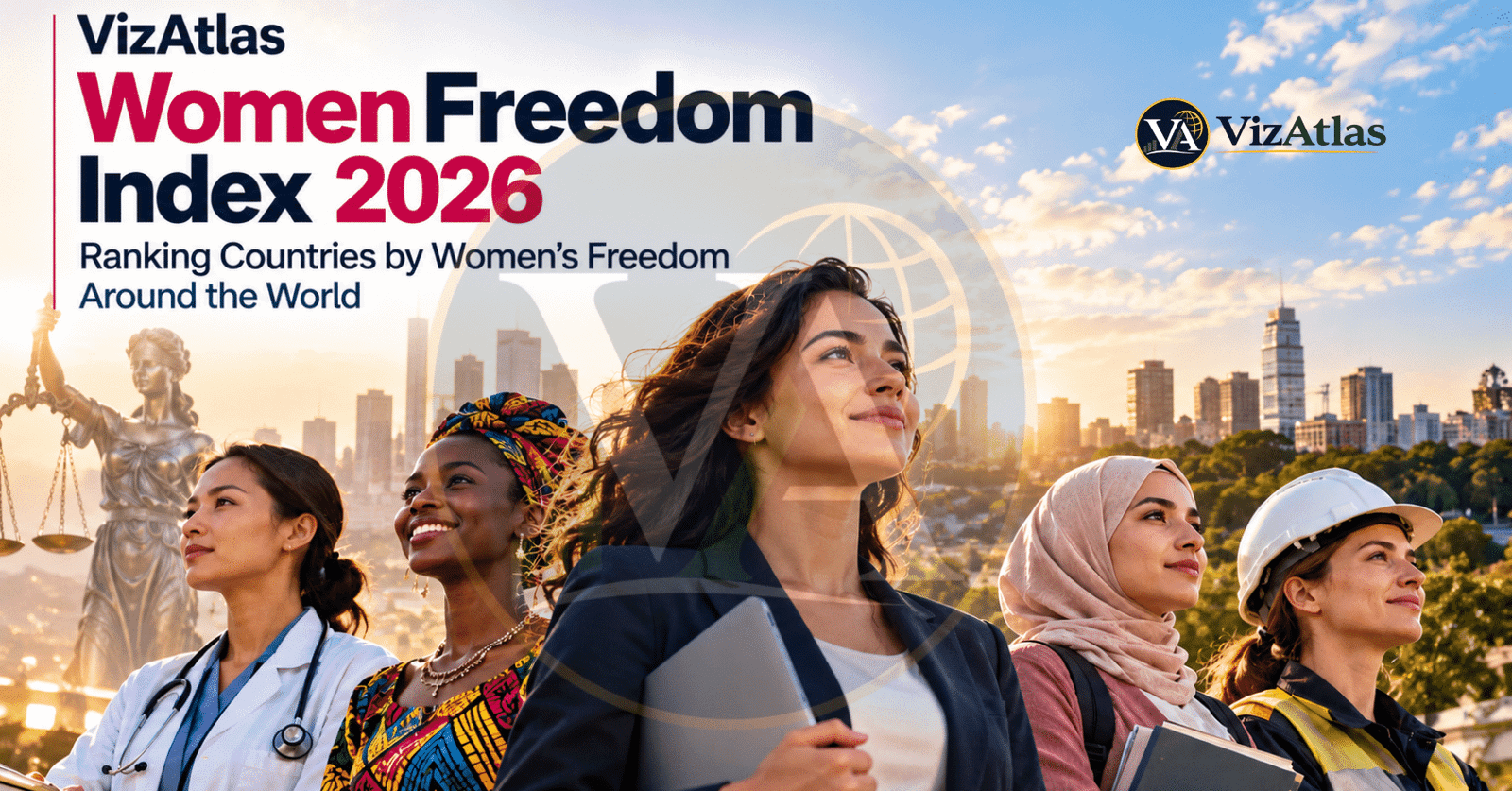
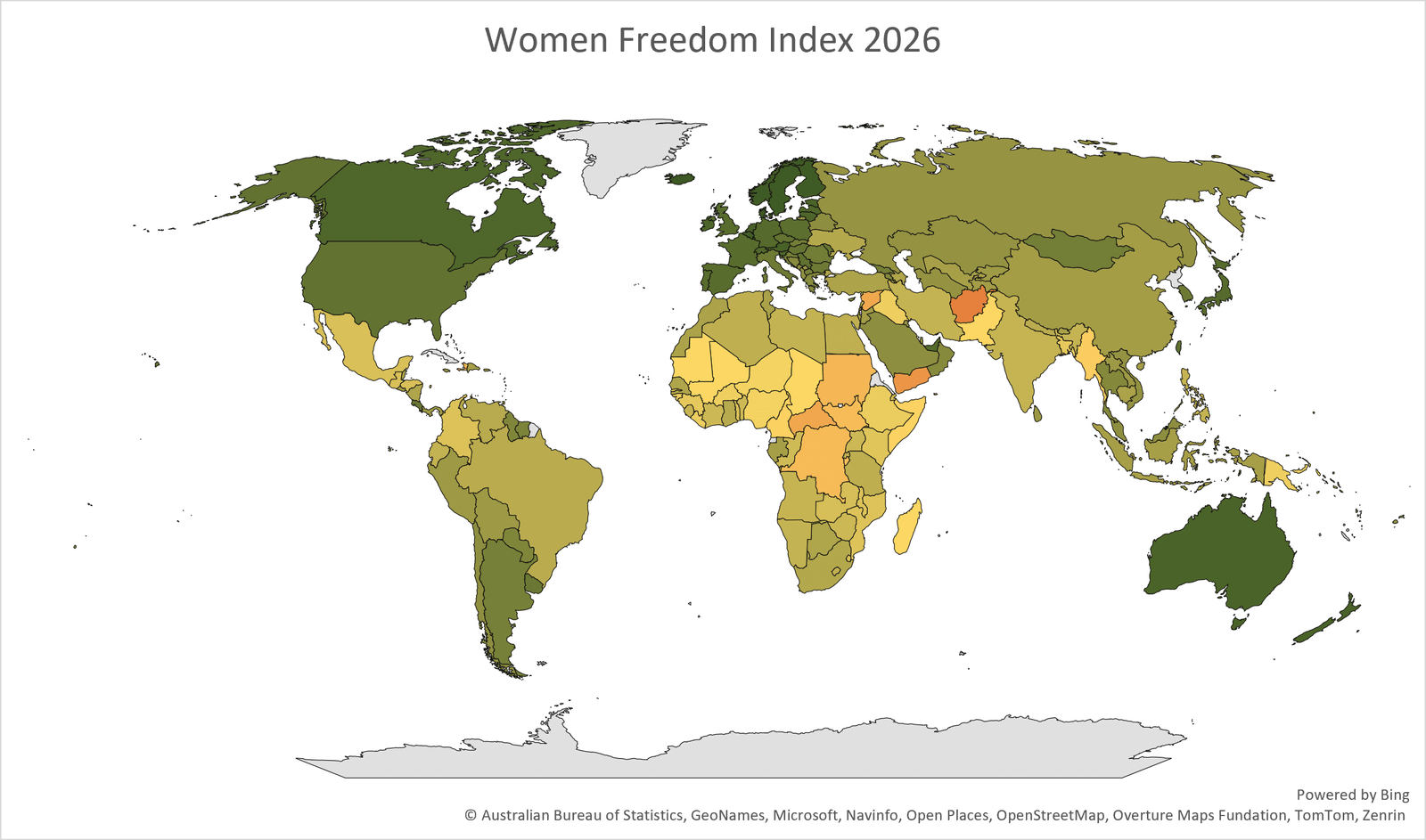
The VizAtlas Women Freedom Index 2026 takes this seriously. It uses a perspective—a freedom-first approach—to evaluate the conditions for women’s freedom. It looks at equality, personal and civic freedoms, safety, mobility, economic rights, property ownership, education, access to justice and how well institutions actually work. The index covers 181 countries and economies giving each a score between 0 and one 100. A higher score means better conditions for women’s freedom.
What the numbers show is not a world where everyone’s either free or unfree. Instead there is a spread. Some countries are near the top— ahead of others. Many fall in the middle with varying degrees of progress for women. At the bottom end some countries offer very little in terms of actual freedom for women. This pattern appears different across the globe.
And perhaps the important insight is this: Women freedom is not simple but multidimensional.
A country can perform well in one area—like education—yet do poorly in another—like safety. Laws can improve fast. The institutions that enforce them may lag behind. People can gain voice without having economic power. Formal equality can exist while real-life experiences remain unequal.
So the index does not give a judgment. It acts more like a map—one that helps us see the path societies are, on as they move from rights to real opportunities.
What Is the Women Freedom Index?
“Women Freedom Index 2026” is a tool that helps us see how situations affect women’s ability to make choices about their lives.
This idea means more than gender equality.
Equal treatment usually asks the question, “How similar are the outcomes for women and men?” That is what we would normally expect. Freedom however asks a question: “What rights, choices, protections and opportunities do women actually have?” That difference matters.
The index that focuses on freedom looks at whether women can take part in society, travel freely, make decisions for themselves and their families, get an education, own and manage property, work and earn money, join politics and find protection and justice, when their rights are broken.
Therefore in VizAtlas Index, rights, protection and autonomy carry the weight in the framework, not just outcomes. Seventy percent of this weight goes to rights, protection and autonomy while about thirty percent focuses on women‑specific outcomes.
The design uses eight pillars: fundamental rights and legal equality; safety and protection from violence; personal and family autonomy; movement and identity; economic and property rights; education and equal opportunity; political and civic rights; and justice, enforcement and institutions.
What this structure deliberately skips is the idea that women are best off as unpaid workers. Freedom is bigger than any number.
| Rank | Country | Women Freedom Index Value |
|---|---|---|
| 1 | Denmark | 93.90 |
| 2 | Iceland | 93.20 |
| 3 | Norway | 92.40 |
| 4 | Sweden | 92.40 |
| 5 | Finland | 92.10 |
| 6 | Luxembourg | 91.80 |
| 7 | Belgium | 91.20 |
| 8 | Netherlands | 90.50 |
| 9 | Austria | 89.80 |
| 10 | New Zealand | 89.80 |
| 11 | Australia | 89.60 |
| 12 | Estonia | 89.60 |
| 13 | Ireland | 89.10 |
| 14 | Slovenia | 88.90 |
| 15 | Lithuania | 88.70 |
| 16 | Canada | 88.50 |
| 17 | Latvia | 88.40 |
| 18 | Singapore | 88.40 |
| 19 | Switzerland | 87.70 |
| 20 | United Arab Emirates | 87.20 |
| 21 | Germany | 86.90 |
| 22 | Japan | 86.60 |
| 23 | France | 86.40 |
| 24 | United Kingdom | 86.40 |
| 25 | Spain | 86.20 |
| 26 | Portugal | 86.10 |
| 27 | Poland | 85.40 |
| 28 | Taiwan | 85.40 |
| 29 | Serbia | 84.40 |
| 30 | Malta | 84.10 |
| 31 | United States | 84.00 |
| 32 | Czechia | 83.20 |
| 33 | Hungary | 83.20 |
| 34 | Costa Rica | 82.40 |
| 35 | Uruguay | 82.20 |
| 36 | Moldova | 82.10 |
| 37 | South Korea | 81.50 |
| 38 | Bulgaria | 81.40 |
| 39 | Italy | 81.10 |
| 40 | Seychelles | 81.00 |
| 41 | Hong Kong | 80.90 |
| 42 | Barbados | 80.70 |
| 43 | Romania | 80.10 |
| 44 | Mongolia | 79.90 |
| 45 | Georgia | 79.80 |
| 46 | Slovakia | 79.70 |
| 47 | Argentina | 79.10 |
| 48 | Croatia | 78.80 |
| 49 | Grenada | 78.70 |
| 50 | North Macedonia | 78.70 |
| 51 | Suriname | 77.90 |
| 52 | Cyprus | 77.00 |
| 53 | Guyana | 77.00 |
| 54 | Paraguay | 76.80 |
| 55 | Bahrain | 76.50 |
| 56 | Armenia | 76.20 |
| 57 | Thailand | 76.10 |
| 58 | Oman | 75.50 |
| 59 | Bosnia and Herzegovina | 75.30 |
| 60 | Greece | 75.20 |
| 61 | Montenegro | 74.30 |
| 62 | Cabo Verde | 74.10 |
| 63 | Belarus | 73.90 |
| 64 | Chile | 73.90 |
| 65 | Palau | 73.90 |
| 66 | Saudi Arabia | 73.90 |
| 67 | Malaysia | 73.80 |
| 68 | Albania | 73.10 |
| 69 | Fiji | 73.10 |
| 70 | Kuwait | 72.30 |
| 71 | Qatar | 72.30 |
| 72 | Kazakhstan | 72.20 |
| 73 | Vietnam | 72.10 |
| 74 | Turkmenistan | 72.00 |
| 75 | Russia | 71.80 |
| 76 | Puerto Rico | 70.70 |
| 77 | Sri Lanka | 70.60 |
| 78 | Maldives | 70.40 |
| 79 | Jamaica | 70.30 |
| 80 | Bolivia | 70.10 |
| 81 | Peru | 70.10 |
| 82 | Kosovo | 70.00 |
| 83 | Laos | 69.80 |
| 84 | Israel | 69.70 |
| 85 | Kyrgyzstan | 69.70 |
| 86 | Panama | 69.60 |
| 87 | El Salvador | 69.10 |
| 88 | Jordan | 68.60 |
| 89 | China | 68.50 |
| 90 | Samoa | 68.50 |
| 91 | Tajikistan | 68.50 |
| 92 | Tonga | 68.50 |
| 93 | Trinidad and Tobago | 68.50 |
| 94 | Gabon | 67.90 |
| 95 | Mauritius | 67.90 |
| 96 | Indonesia | 67.80 |
| 97 | Dominican Republic | 67.50 |
| 98 | Uzbekistan | 67.40 |
| 99 | Bhutan | 67.30 |
| 100 | Tunisia | 67.10 |
| 101 | Marshall Islands | 67.00 |
| 102 | Morocco | 66.80 |
| 103 | Timor-Leste | 66.80 |
| 104 | Belize | 66.70 |
| 105 | Cambodia | 66.70 |
| 106 | Türkiye | 66.40 |
| 107 | Nicaragua | 65.90 |
| 108 | Botswana | 65.80 |
| 109 | Solomon Islands | 65.80 |
| 110 | Senegal | 65.70 |
| 111 | Azerbaijan | 65.30 |
| 112 | Kiribati | 65.20 |
| 113 | Micronesia | 64.80 |
| 114 | South Africa | 64.80 |
| 115 | Vanuatu | 64.60 |
| 116 | Ukraine | 64.50 |
| 117 | Ghana | 63.90 |
| 118 | Venezuela | 63.80 |
| 119 | Brazil | 63.20 |
| 120 | Nepal | 63.10 |
| 121 | Rwanda | 62.40 |
| 122 | Tanzania | 62.40 |
| 123 | Algeria | 62.10 |
| 124 | São Tomé and Príncipe | 62.00 |
| 125 | Egypt | 61.70 |
| 126 | Lesotho | 61.40 |
| 127 | Ecuador | 61.20 |
| 128 | Iran | 60.80 |
| 129 | Libya | 60.80 |
| 130 | Namibia | 60.80 |
| 131 | India | 60.70 |
| 132 | Philippines | 60.70 |
| 133 | Angola | 60.10 |
| 134 | Sierra Leone | 60.10 |
| 135 | Comoros | 59.00 |
| 136 | Zimbabwe | 59.00 |
| 137 | Côte d’Ivoire | 58.90 |
| 138 | Benin | 58.70 |
| 139 | Uganda | 58.70 |
| 140 | Republic of the Congo | 58.30 |
| 141 | Lebanon | 57.50 |
| 142 | Zambia | 56.60 |
| 143 | Togo | 56.20 |
| 144 | Guatemala | 56.10 |
| 145 | Honduras | 56.10 |
| 146 | Djibouti | 56.00 |
| 147 | Mexico | 55.80 |
| 148 | Eswatini | 55.60 |
| 149 | Colombia | 55.10 |
| 150 | Malawi | 54.90 |
| 151 | Mozambique | 54.80 |
| 152 | Kenya | 54.20 |
| 153 | Gambia | 52.80 |
| 154 | Guinea | 52.70 |
| 155 | Bangladesh | 52.60 |
| 156 | Ethiopia | 51.60 |
| 157 | Liberia | 51.20 |
| 158 | Iraq | 51.00 |
| 159 | Guinea-Bissau | 50.80 |
| 160 | Burkina Faso | 50.70 |
| 161 | Papua New Guinea | 50.70 |
| 162 | Nigeria | 49.50 |
| 163 | Niger | 49.20 |
| 164 | Mali | 47.80 |
| 165 | Chad | 47.60 |
| 166 | Mauritania | 47.50 |
| 167 | Palestine | 46.90 |
| 168 | Madagascar | 46.60 |
| 169 | Pakistan | 46.20 |
| 170 | Somalia | 45.50 |
| 171 | Cameroon | 45.10 |
| 172 | Myanmar | 44.20 |
| 173 | South Sudan | 41.10 |
| 174 | Burundi | 40.70 |
| 175 | Democratic Republic of the Congo | 40.50 |
| 176 | Haiti | 39.90 |
| 177 | Sudan | 39.70 |
| 178 | Syria | 36.40 |
| 179 | Central African Republic | 36.20 |
| 180 | Yemen | 32.30 |
| 181 | Afghanistan | 27.90 |
What Does “Women’s Freedom” Actually Mean?
The phrase sounds intuitive until measurement begins.
Freedom of movement is not the same as economic freedom. Economic freedom is not the same as freedom in marriage and family. Legal equality is not the same as access to justice. Political representation is not the same as political power.
So the framework moves beyond the idea that women’s freedom as a single thing. It recognizes that women’s freedom can mean multiple things at once.
Legal equality and fundamental rights mean whether women have rights and protections.
Safety and protection from violence focuses on violence against women, not on national security measures.
Personal and family autonomy refers to a person’s ability to make choices about marriage, family life and personal matters.
Movement and identity address women’s right to move, to not be denied their civil or legal identity and to take part in public life.
Economic and property rights include access to jobs, capital, assets, property, business opportunities and financial services.
Education and equality of opportunity are essential for developing girls capabilities and making sure women fully join society.
Political and civic rights focus on women’s participation and representation, not on overall democracy scores.
Finally there is justice, enforcement and institutions—the toughest question that makes people uneasy but must be asked: What happens when rights exist on paper but are ignored in reality?
A right that cannot be practically exercised is not a right all. It becomes a way of taking away that right.
The Big Pattern:
Freedom Is Institutional
The general characteristic about the 2026 data is that women’s freedom is strongly related to institutionality.
That does not mean, however that institutions are the thing that matters. Culture, economic development, conflict, historical events, demographics and social norms—they all play a role.
It is institutions that make rights usable.
What about the difference between a law and an enactable law?
A law can outlaw discrimination. If a woman cannot get an advocate, cannot report abuse without risking her safety, cannot document abuse and if public authorities do not respond properly—then the real value of that law is greatly reduced. The law may say one thing. The actual experience is quite different.
That is why the index gives strong weight to justice and enforcement. It doesn’t assume that law alone is enough.
The same idea applies to rights.
Right To Work: You may have the right to work. Do you really have equal access to jobs?
Right To Own Property: You may have the right to own property. Do you have the same control over your assets?
Right To Establish a Business: You may have the right to start a business. Are you blocked by lack of finance, childcare, social networks or outdated expectations?
There is a new space for Freedom to live—a space, between the words written in the statute book and the real world where those words are either realized or ignored.
Safety Is Not the Same as General National Security
An important part of the VizAtlas methodology is that safety is clearly defined as violence that impacts women. This difference is not minor. A country might have low levels of general violence but still experience extreme forms of violence against women. On the other hand, a place with high overall insecurity could see different patterns of violence affecting women.
When these ideas are mixed into a broad “safety” score, key differences can get lost. That’s why women’s protection is treated as its separate dimension within the Women Freedom Index.
This focus connects directly to the Women, Peace and Security framework. The Women, Peace and Security Index for 2025/26 covers 181 countries and economies. It tracks women’s progress in inclusion, justice and security using 13 indicators. Data comes from sources, like the United Nations, the World Bank and Gallup.
For the definition of the VizAtlas index, this current and comprehensive body of evidence plays a central role. It guides the index’s approach while also fitting into a freedom-first way of thinking.
Legal Equality Has Layers
The obvious mistake when doing gender analysis is to treat legal equality as if it’s just two options—either equal or not equal. That’s not how things work in real life.
Here’s the problem: The Women, Business and the Law framework from the World Bank evaluates the policy environment across eight key areas of women’s lives—safety, mobility, work, pay, marriage, parenthood, childcare, entrepreneurship, assets and pensions—for 174 economies. The newer version of this framework has added a different way of looking at the data.
That shift matters a lot. Because there’s a difference between:
What the law says on paper.
How institutions are set up to support it.
What actually happens in everyday life.
In the 2026 World Bank report, the legal dataset now includes 190 economies. It shows that women today still only have two-thirds of the legal rights that men have around the world. Even more, supportive systems and their application are much weaker than the laws themselves suggest.
This gap, between rights and real-world practice is one of the most important things to watch for in any freedom index.
Political Rights Require More Than Democracy
Freedom in Politics is another area where measurement can mislead.
A democratic score should not be seen as showing women’s access to politics. A country can hold elections yet the level of women’s representation in legislatures, the executive or other decision‑making bodies could be low.
Having said that the method used by VizAtlas focuses on women’s civic and political rights, not on a democracy score.
The research matches the literature, which keeps finding political representation as one of the most persistent gaps in gender equality.
The 2025 Global Gender Gap Index by the World Economic Forum showed that the worldwide gap in women empowerment was larger than the gaps, in education and health. The index calculates participation, educational attainment, health and survival and political empowerment separately.
In the 2026 version, this approach is extended into four dimensions showing that measuring gender has become more and more a separate part of political participation, not just a side effect of general institutional development.
Freedom and Development Are Related — But Not Identical
It would be easy to assume that richer societies automatically offer freedom to women. There is a connection, yes— But the full picture is much more complicated.
Wealth can help governments fund education, healthcare, legal systems and social safety nets. It can also create chances for women to earn their own income. But Wealth alone doesn’t determine rights. It doesn’t decide whether women can participate in politics. It doesn’t guarantee control over their lives.
This is clear from data by the World Economic Forum. In its 2025 report, it found that gender equality varies widely across income levels. Surprisingly some lower-income countries outperform richer ones in certain areas of women’s rights. That’s a reminder: development isn’t a simple fix. It’s not about money.
Real freedom for women isn’t, about income alone. It’s about the institutional environment—how laws treat them how culture sees them and how power is shared.
Conclusion: Freedom Is More Than a Right on Paper
The Vision Atlas Womens Freedom Index 2026 shows a world that is not simply split between freedom and unfreedom. It reveals a deeper and more complex divide—one that is not black and white but layered and complicated.
In 181 countries and economies, the scores goes from 27.9 to 93.9. The global average is 68.31 while median listed is 68.50. The top ten countries and economies have a score of 91.71. The bottom ten average 37.89.
These numbers show a large gap across the world.
The bigger truth is this: there is no winner and no loser in the fight for women’s freedom. Freedom for women is not something that just happens. It is not a moment or a single law that ends the struggle.
Freedom is built in layers. It starts with rights. It includes safety, personal autonomy, the ability to move freely, access to jobs and money, education, the right to take part in politics and justice when things go wrong. Each of these layers supports the others. When all of them work together freedom becomes strong and lasting. If even one layer is weak or missing—like safety or economic opportunity—then freedom becomes fragile. Even if laws are perfect, real freedom cannot be fully achieved.
The map is not data. It is a reminder. Freedom is not what is written in law. It is also what can be lived. A right on paper is important but a right that can truly be used—every day in real life—is more valuable.
This gap between the law and reality is where most of the world’s work remains. That is the space where progress must start. That is where the real fight, for women’s freedom must go on.
Subscribe to our $1 newsletter to get new Data and Maps from around the world on various different topics every month. Click here now to join.
Sources
- As a base for a 2026 global comparable dataset, we selected the 2025/26 Women, Peace and Security Index (WPS). This is the recent comprehensive dataset that uses 13 indicators across women’s inclusion, justice and security in 181 countries and economies.
- Next we looked at the World Bank Women, Business and the Law 2026. This dataset covers 190 countries. Examines legal systems in eight key areas: safety, mobility, work, pay, marriage, parenthood, child care, entrepreneurship, assets and pensions. It offers a basis for comparing how laws affect women’s rights globally.
- Another source is the WEF Global Gender Gap Report 2026. This report has been tracking gender gaps for the 12 years. It covers 145 economies and measures disparities in participation and opportunity educational attainment, health and survival and political empowerment.
- We also considered policy and political indicators. The CFR Women’s Power Index measures both the relative position of women across all political institutions in 193 UN member states. This provides a picture of women’s presence and influence, in politics worldwide.