Work-Life Balance Ranking 2025–2026: Best to Worst Countries, Scores & Global Comparison
The modern working day has left the office behind.
It follows people onto phones, into bedrooms, through dinner, across weekends and sometimes into the few minutes after waking up. A job may officially end at 6 p.m.. The notification arriving at 8:47 PM at night, Often suggests otherwise.
That is why work‑life balance is one of the important ways to think about quality of working life.
The question is no longer how much people earn or how productive an economy is. It is also about what happens to the hours left over after work.
The VizAtlas Work‑Life Balance Index 2025–2026 gives a snapshot of this issue across 60 countries. The index ranges from 86.87 at the top to 26.67 at the bottom creating a 60.20‑point gap between the two ends.
The average score is 55.26 while the median is 54.02. The top 10 entries average 75.49 compared with 36.27 among the bottom 10.
That is not a difference. It suggests that the global experience of balancing employment with personal time, family responsibilities, rest and life outside work varies a great deal.
The most interesting story is not simply where individual countries appear in the ranking. It is what the distribution tells us about the changing relationship, between time, work and life.
What Is Work-Life Balance?
Work‑life balance is the degree to which a job fits with the rest of a person’s life. That sounds simple but Work‑life balance has many dimensions.
The number of hours you work matters. The steadiness of those hours matters. The chance to take time off, to step away from work, to look after family, to learn things, to exercise, to meet friends, to sleep well or simply to have a few hours each day when no one calls on you, also matters. All these factors shape work‑life balance.
A person who works a short week may still feel a bad work‑life balance if the schedule keeps changing without warning.
Another person may work a week but can decide when and where to work, which gives them more freedom and can improve work‑life balance.
That is why work‑life balance cannot be summed up by one number of hours.
The International Labour Organization looked at how hours people work and how work is arranged. It found that working hours than people want is linked to poorer work‑life balance. The studies also point out that flexible work and enough rest are very important for work‑life balance.
The real problem is not just how hours you put in for work‑life balance. It is about how control you have over your own time, for work‑life balance.
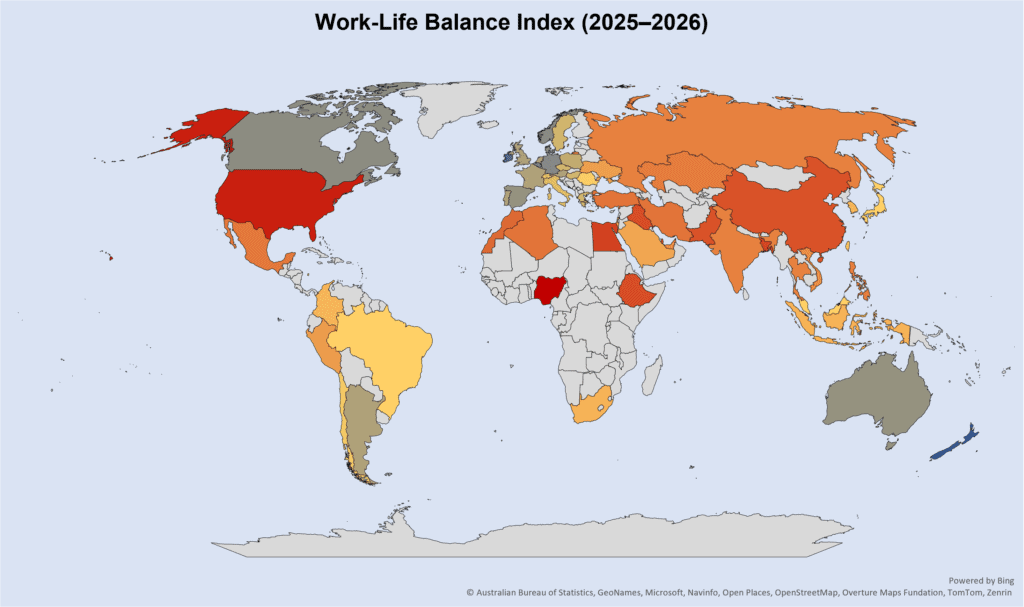
The Numbers Behind the 2025–2026 Ranking
| Rank | Country | Work-Life Balance Index Value |
|---|---|---|
| 1 | New Zealand | 86.87 |
| 2 | Ireland | 81.17 |
| 3 | Belgium | 75.91 |
| 4 | Germany | 74.65 |
| 5 | Norway | 74.20 |
| 6 | Denmark | 73.76 |
| 7 | Canada | 73.46 |
| 8 | Australia | 72.10 |
| 9 | Spain | 71.94 |
| 10 | Finland | 70.86 |
| 11 | United Kingdom | 69.68 |
| 12 | Netherlands | 68.97 |
| 13 | Portugal | 68.65 |
| 14 | Argentina | 68.35 |
| 15 | Austria | 68.01 |
| 16 | France | 67.62 |
| 17 | Poland | 65.33 |
| 18 | Hungary | 63.38 |
| 19 | Czechia | 63.06 |
| 20 | Sweden | 62.92 |
| 21 | Greece | 62.84 |
| 22 | Italy | 60.52 |
| 23 | Switzerland | 60.32 |
| 24 | Chile | 58.02 |
| 25 | Singapore | 57.85 |
| 26 | Romania | 57.49 |
| 27 | Malaysia | 57.03 |
| 28 | Brazil | 56.63 |
| 29 | Japan | 56.54 |
| 30 | Taiwan | 54.61 |
| 31 | South Korea | 53.42 |
| 32 | Colombia | 53.38 |
| 33 | South Africa | 52.17 |
| 34 | Indonesia | 52.07 |
| 35 | Saudi Arabia | 50.79 |
| 36 | Israel | 49.79 |
| 37 | Ukraine | 49.77 |
| 38 | Peru | 49.18 |
| 39 | Vietnam | 47.08 |
| 40 | United Arab Emirates | 47.01 |
| 41 | Thailand | 45.86 |
| 42 | India | 45.81 |
| 43 | Hong Kong | 45.72 |
| 44 | Russia | 45.29 |
| 45 | Philippines | 44.62 |
| 46 | Kazakhstan | 44.57 |
| 47 | Mexico | 44.04 |
| 48 | Algeria | 43.63 |
| 49 | Iran | 43.11 |
| 50 | Türkiye | 43.06 |
| 51 | Morocco | 41.59 |
| 52 | China | 38.68 |
| 53 | Qatar | 38.33 |
| 54 | Pakistan | 38.27 |
| 55 | Iraq | 37.66 |
| 56 | Ethiopia | 37.61 |
| 57 | Bangladesh | 36.91 |
| 58 | Egypt | 35.77 |
| 59 | United States | 31.17 |
| 60 | Nigeria | 26.67 |
The Dataset includes 60 countries ranked by a work-life balance index. The scores range from 26.67 to 86.87. The highest value recorded is 86.87. The lowest is 26.67. In between these extremes there is a middle section.
The average score across all 60 countries is about 55.26. The median score is 54.02. Since the average is slightly higher than the median, the data shows that the upper end of the scale is pulling the mean up a bit.
The 25th percentile is around 44.61. The 75th percentile is about 67.72. That means the middle half of the countries fall within a range of 23 points.
Looking at thresholds makes the pattern clearer. Two countries score above 80. Three countries reach least 75. Ten countries score 70 or higher. Seventeen countries hit 65 or more.
On the hand 35 out of 60 countries score 50 or above. That leaves 25 countries scoring below 50.
This creates a pattern: a tiny group at the top, a large group in the middle and a significant broad number at the bottom. It signals that strong work-life balance outcomes are rare in this dataset. Most countries do not reach the levels. The data shows a tail of lower scores and a narrow peak, at the top.
Working Hours Still Matter
Even though flexibility is becoming more important, the time people spend working is still a part of a good work‑life balance.
Each extra hour of work takes away an hour that could be used for sleeping, exercising, caring for children, meeting friends studying, relaxing or taking part in community life.
We feel that cutting work hours does not always improve well‑being.
Income matters.
Job security matters.
Career opportunities matter.
A shorter week that comes with insecurity, may not feel like a better balance at all. We see why the best work‑life systems are about more than cutting hours. They combine working time, fair pay, predictable schedules, leave, flexibility and worker autonomy.
From the study conducted by ILO, We see a range of working‑time patterns worldwide. During the study, we get to know that more than a one-third of workers worked over 48 hours a week while a large group worked less than 35 hours.
So the problem is not just that everyone works too much. It is that people have different relationships with working time.
Why Flexibility Is Not Automatically Freedom
Flexibility is one of the misunderstood ideas in today’s job market. On paper, flexibility in work feels like a win.
Work from home. Pick your hours. Skip commuting. Move your schedule around family commitments.
Flexibility has two sides.
The first side’s employee‑controlled flexibility: a worker really decides when and where work gets done. The second side is employer‑driven flexibility: the worker must stay available whenever business needs come up.
They can look alike from the outside. But they are not.
Research from the ILO says that worker control over schedules can make work‑life balance better while some irregular or non‑standard work times can make work and family clash more.
The crucial thing is not just flexibility. It is who controls flexibility.
The Rise of Remote Work Changed the Equation
The pandemic sped up one of the tests of how work is organized in recent times. We remember when the those changes began to feel like a normal.
Many people who used to go to offices started working from home, when their jobs could do that. We saw many of our friends and family making the shift.
This led to a discovery about remote work. It was like finding a hidden gem.
For some workers, getting rid of the commute brought back a part of their life. We felt the relief ourselves, when we no longer had to rush. An hour that used to be lost in traffic, could now be spent on breakfast with family, exercise, sleep or more time to begin the day calmly. We have seen that, that extra time made a difference.
Remote work also brought a new problem. It made us think about the balance between work and personal life.
When the workplace moved into the home, the clear line between work and personal life faded and the line blurred quickly.
The office door no longer closed at the end of the day because there was no office door.
The ILO says that telework can give people freedom and cut down commuting time but it can also bring risks of longer work hours and blurred lines between work and personal life. And we also agree that the benefits come with challenges too.
The lesson is not that remote work is good or bad. We think the truth lies elsewhere. It is that work-life balance depends a lot, on how work’s organized.
The Importance of Predictability
Imagine two workers who both work forty hours a week. One knows the schedule a month in advance and can plan family commitments, appointments, exercise and social activities. While the other discovers each weeks schedule a few days beforehand.
The workers total working time is identical. But the workers experience of time is not.
Predictability is therefore a component of work‑life balance. A predictable schedule allows people to plan lives.
An unpredictable schedule pushes life to adapt to work. This becomes especially important for people with children, caregiving responsibilities or multiple jobs.
Work‑life balance is therefore about having enough time and partly, about knowing when that time will be available.
Work-Life Balance Is Also About Family
We also noticed that the phrase “work-life balance” can also sound like a personal lifestyle choice as well. But It is much bigger than that.
Working schedules decides, if parents can spend time with children, if people can care for relatives, if partners can coordinate duties and if people can join community life.
The OECD Studies has looked again and again at compatibility by studying things like parental leave, childcare and flexible working arrangements. It says that work‑life balance is a part of well‑being and stresses, how flexible working arrangements help workers match job duties with family duties.
This shows that work‑life balance is partly a question of infrastructure.
A worker does not live in isolation. Their working schedule mixes with schools, childcare, public transportation, healthcare, family patterns and community events. A society that makes those systems easier to coordinate can really give people usable time.
The Productivity Paradox
There has been an assumption that working longer hours, automatically produces more output. But the relationship is more complicated than we can imagine.
The ILO reports that longer working hours are generally linked to lower unit labour productivity, whereas shorter working hours can be linked to productivity.
That does not mean that simply cutting working hours will automatically make every organization more productive. It means that the relationship between time and output is not linear.
Fatigue matters.
Attention matters.
Recovery matters.
Burnout matters.
A worker who spends ten hours present at work is not necessarily producing twice as much, as someone who works five highly focused hours. This is why the future of work-life balance may depend less on asking people to work more on asking organizations to work smarter.
What the Data Does Not Tell Us
The Ranking Does Not Measure Happiness
A high work-life balance score does not automatically mean that people are happier. It is easy to jump to that conclusion.
Happiness depends on other variables and we often look for answers for it.
Income, housing costs, health, social relationships, job security, inequality, safety, environment and personal circumstances all influence well-being. All these factors weave together in our lives.
Work-life balance is one piece of the puzzle. It is a piece that many of us try to fit. It is a piece because time is a resource that cannot be saved indefinitely. Money can be earned again. It is not as valuable as time. Money can be earned again and again. A missed hour with family cannot be deposited into a bank account. Retrieved later. That is why moments matter.
That makes time unusually valuable. We should remind ourselves to use it thoughtfully.
Work-Life Balance and the Cost of Living
Another complication is income. Income makes a difference.
Imagine two workers who work the same hours. and picture them walking together. One earns enough to cover housing, food, healthcare and transportation. They can still enjoy a few nights out. While the other spends most of their income simply surviving. Their days feel like a struggle.
Their work-life experiences are unlikely to feel identical and each one feels a different kind of pressure.
This is why work-life balance should be interpreted alongside security. Without security, balance might feel like a mirage. Reducing working hours without ensuring income, can create a different form of pressure. People might feel more stressed.
The sustainable balance is therefore not necessarily the shortest possible workweek. It matters how hours we actually get to spend while working and also with family.
It is a situation where people have economic security, reasonable working time predictable schedules and meaningful control over their personal lives. That is what we truly seek.
The Future of Work-Life Balance
The decade from now could make the work-life question even more complicated. Technology is moving fast.
Artificial intelligence is increasingly capable of automating tasks, generating content, analyzing information and assisting with decision-making. It is like a tool in the toolbox. In theory productivity gains could create an opportunity.. We need to decide how to use it.
If organizations produce more with human time, societies could choose to convert some of those gains into shorter working hours, greater flexibility and more personal time. That could mean leisure for many.
Productivity gains do not automatically translate into leisure. Sometimes they simply add work. They can also translate into output expectations. We often feel the pressure to deliver more. That means technology itself will not determine the future of work-life balance. Decisions are still made by us.
The choices surrounding technology will shape how we live.
The same productivity improvement could produce a workweek in one organization and a larger workload, in another. It depends on who makes the choice. The machine does not make that decision. We are the ones deciding.
Conclusion: The Most Valuable Benefit May Be Time
The phrase “work-life balance ranking” may make the topic seem like an international scoreboard. This is more meaningful than that.
Behind each index value lies a question about how societies organize one of the worlds limited resources: human time.
The strongest work-life systems are not always the ones where people work the least. These systems make working time fit better with the rest of life—schedules are predictable, rest is protected, flexibility is meaningful, family duties can be. Technology does not turn every spare minute into possible work time.
The VizAtlas Work-Life Balance Index 2025–2026 shows a striking spread. Across the 60-country dataset scores range from 26.67 to 86.87. The difference between the lowest values is more than 60 points and the gap between the average top‑10 and bottom‑10 scores is over 39 points.
The broader evidence explains why these differences matter. The ILO finds that many working hours and insufficient rest can harm workers’ well‑being while flexible arrangements can improve balance when workers truly control their schedules.
The future challenge is not simply to make people work less. This challenge is to make work fit better into life.
Because economic progress can be measured by output, income and productivity. But one of the measures of a society’s relationship with its people may be much simpler:
How much of your life still belongs to you after the working day ends?
Subscribe to our $1 newsletter to get new Data and Maps from around the world on various different topics every month. Click here now to join.
Sources
- Remote Global Life-Work Balance Index 2025: international benchmark and source framework. Remote looked at the worlds sixty economies by GDP using employment figures and quality-of-life signs and gave each a score from zero to one hundred. The data came from April 2025.
- ILO ILOSTAT: working‑time data and definitions for hours actually worked and excessive working hours. ILOSTAT gives standardized working‑time statistics that help compare countries.
- OECD Time Use Database: leisure, paid work/study, unpaid work and personal‑time data that we cross‑check when OECD data exist.
- OECD Well‑being Database / Better Life Index: work and job‑quality signs and a normalization framework.
- Global Peace Index: safety component that is part of the core international work‑life framework. Remote uses Global Peace Index safety scores directly.
Methodology
The VizAtlas Work‑Life Balance Index 2025–2026 works on a scale from zero to one hundred. A higher number means a mix of good working conditions more free time and better support, for employees.
The composite framework relies on these pillars:
| Factor | Weight |
|---|---|
| Working Hours & Time Availability | 25% |
| Paid Leave & Family Benefits | 20% |
| Income & Employment Conditions | 15% |
| Healthcare & Social Protection | 15% |
| Safety & Personal Well-being | 10% |
| Happiness & Quality of Life | 10% |
| Workplace Inclusion | 5% |
| Total | 100% |