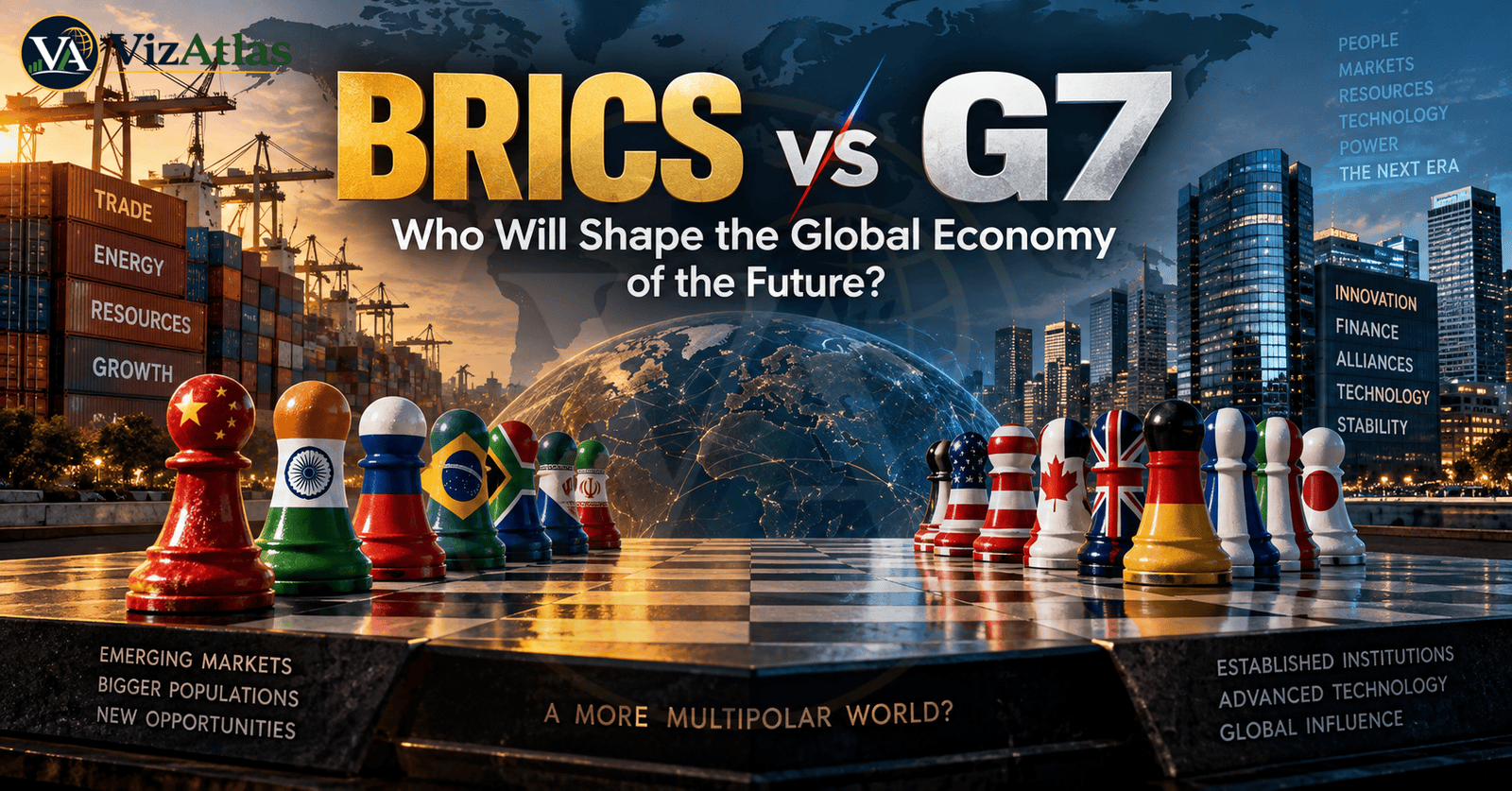
BRICS vs G7 2026: GDP, Economic Power, Global Influence & the Future of the World Economy
For years the way the world economy worked was tied to a small group of rich industrial countries. These countries created most of the organizations, money systems and trade setups that still affect how countries deal with each other today.
The Countries where power lies in the economy are changing.
The growth of BRICS has created another center of power: bigger populations, faster-growing markets, lots of natural resources, more factories and a stronger wish to have more say in how the world is run. At the same time, the G7 still has big advantages in money systems, fancy technology, strong organizations, rich countries and old friendships.
This makes the difference between BRICS and the G7 more interesting than just looking at how much money each group makes.
It is really about what kind of power will be most important in the few years.
If just having more money decided who is in charge the situation would already be different. Calculations based on PPP GDP (how much money people have to buy things with) show that BRICS+ has about $80.4 trillion in 2025 while the G7 has about $58.6 trillion. This shift wasn’t new: BRICS+ passed the G7 on this measure around the middle of the 2010s.
The real money numbers show a different picture and things, like technology, stock markets, money that other countries keep, military strength organizations and alliances add even more details.
So the real question is not just if BRICS will surpass the G7. It is whether the world is moving from one economic center to a system where power is shared more widely.
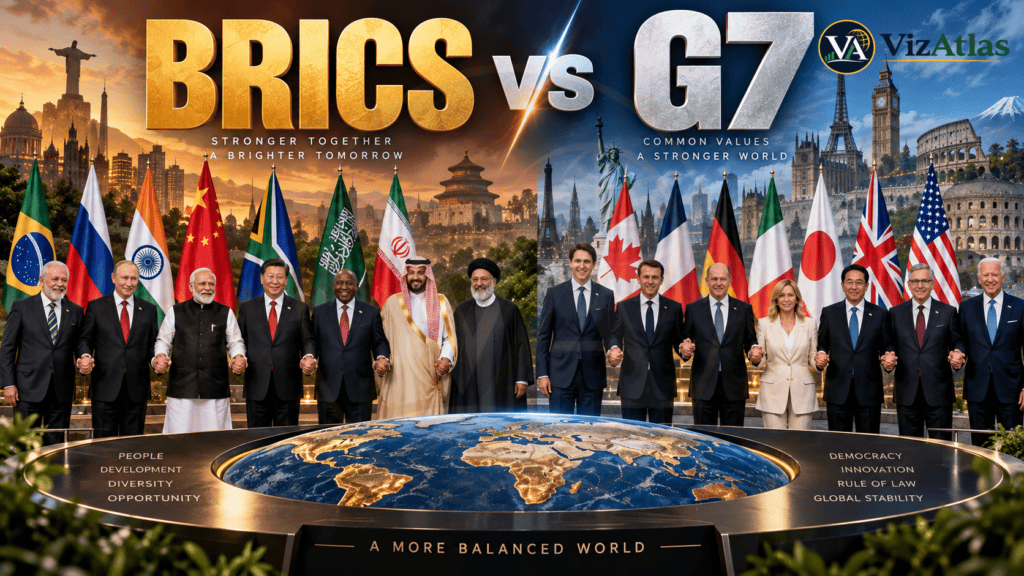
What Are BRICS and the G7?
BRICS started as a group of big emerging economies. Over time it has turned into a platform for political and economic cooperation. By 2025 it had eleven members and a special category for partner countries. Its main goals are to boost cooperation among emerging economies raise the voice of the Global South in institutions and push for changes in how global governance works.
The G7 is very different in how it started and how it works. It is a group made up of seven advanced economies plus the European Union. These countries meet every year to talk about global issues, global politics and international policy. Their meetings help them stay aligned on matters.
That difference is important.
BRICS is not the same as an economic union for developing countries. It does not have a shared currency, a single market or a government that rules over all members. There is no treaty that defines BRICS. It does not have a set budget or a permanent office to run things. Decisions are made when all members agree.
The G7 is not a government either. Its strength comes from the influence of its members not from political control. The leaders of these economies use their combined weight to shape global decisions.
So neither group is like the European Union, in any way.
Both are coordination spaces. Their real power depends on how their members can use their economic clout to act together. When they can, they matter. When they can’t, they don’t.
BRICS+ vs G7 — Country Composition
| BRICS+ — Members & Partner Countries | G7 Countries |
|---|---|
| Brazil | Canada |
| Russia | France |
| India | Germany |
| China | Italy |
| South Africa | Japan |
| Egypt | United Kingdom |
| Ethiopia | United States |
| Indonesia | |
| Iran | |
| Saudi Arabia | |
| United Arab Emirates | |
| BRICS Partner Countries | |
| Belarus | |
| Bolivia | |
| Cuba | |
| Kazakhstan | |
| Malaysia | |
| Nigeria | |
| Thailand | |
| Uganda | |
| Uzbekistan | |
| Vietnam |
The First Big Number: Economic Mass
The biggest benefit of BRICS is Economy size.
When looking at purchasing power parity, the BRICS plus economies together reached about $80.36 trillion in 2025. This is more than the $58.57 trillion of the G7. This makes the BRICS plus economy 37% bigger than the G7 economy using this specific way of measuring.
Purchasing power parity needs to be understood properly. PPP changes currencies based on what money can really buy inside a country. It helps compare how big the production and spending are in countries with different prices. The IMF uses PPP-based GDP weights when it puts together the World Economic Outlook.
It is not the same as power.
A dollar of output measured with PPP does not automatically mean a dollar of money that can be used around the world.
That is why the comparison, between BRICS and the G7 becomes interesting.
BRICS has an economic size while the G7 still has a lot of financial and institutional power. The difference is important.
Think of two engines. One is bigger. Has a lot of power. The other is smaller but connected to a transmission system, global financial networks and strong infrastructure. Just looking at engine size would miss the rest of the machine. Global power works this way.
The Population Advantage
We find the difference in people numbers more striking.
We can see that BRICS covers a large part of all people stretching across big areas of Asia, Africa, the Middle East and Latin America. The G7 by contrast covers a smaller part of the world’s people.
This gives BRICS a possible market for goods and services.
A large population can support:
Growing local markets, workers, more cities, more buying, bigger online economies and richer talent.
Having many people does not automatically mean wealth. We believe that how well those many people work matters.
A country with as many people does not necessarily have twice the economic strength.
Education, roads and buildings health care, savings and investment how well people work, how advanced is technology, How good jobs are decide how well the large number of people turns work into money.
We believe this makes one of the puzzles between BRICS and the G7.
BRICS has the number of people. The G7 has higher average money per person and higher work output. So the future depends in particular on whether the gap, in how people work gets smaller.
The Big Pattern: Power Is Moving Toward the Global South
The important long-term pattern is not that one bloc simply replaces another. It is that the centre of gravity has moved toward emerging economies.
The expansion of BRICS reinforces this trend. The group moved from five members to eleven members and also created a partner‑country mechanism. By 2025, ten countries had partner status.
That expansion matters for reasons beyond membership numbers.
It creates a network that connects major emerging markets with key producers of energy, minerals, agricultural commodities, manufacturing capacity and strategically located trade routes.
The BRICS framework therefore increasingly looks like a platform for South‑South coordination rather than just an alliance of five large emerging economies.
The G7 represents a form of concentration: a relatively compact group of advanced economies with deep financial and technological integration.
The result is a world where power becomes simultaneously more concentrated and more dispersed.
More concentrated because a small number of economies still account for portions of global output, finance, technology and trade. More dispersed because economies, outside the advanced‑economy core are becoming too large to remain peripheral.
The Currency Question
Any talk about economic dominance cannot avoid talking about currencies.
The international financial system is strongly affected by a currencies. These currencies influence trade, central bank reserves, international borrowing and financial markets.
In this context the G7 keeps a structural advantage. The economies of the G7 sit at the heart of financial markets. Their currencies play large roles in international transactions.
BRICS has talked more and more about using currencies, improving cross-border payment systems and cooperating in finance. The New Development Bank of BRICS is one such effort to broaden development financing beyond traditional multilateral channels.
However creating alternatives to an established currency system is very hard.
A global currency needs more than just a large economy. It needs liquid financial markets, the ability to convert currency easily, confidence from investors, predictable legal rules, reliable payment infrastructure and enough international demand, for financial assets written in that currency.
This shows that large economic size does not automatically turn into dominance.
The future might bring diversification without fully replacing the current system. The world does not need one currency to vanish in order for currencies to become more important.
The Trade Battlefield
Trade is another area where the comparison gets tricky.
BRICS economies together have an large amount of manufacturing power. They produce a lot of raw materials. They have plenty of farmland. They have lots of energy sources and fast-growing places where people are buying luxury goods.
The G7 has strong economies that are deeply involved in global value chains they have financial services they have advanced manufacturing they have intellectual property and they provide high-value services.
The WTO has a lot of trade data about what is being exported what is being imported and the different types of products across countries and regions. Their data shows how more connected the worlds trade has become, which makes it hard to compare groups of countries against each other in a simple way.
The interesting thing is how the places where trade happens are changing.
Asia has become an important part of the growth in global trade and the economies that are growing quickly are now very much part of the networks for manufacturing and raw materials. The WTO has kept pointing out how important Asian countries are for the growth in exports around the world.
This gives BRICS an advantage in one way: some of the members are in key spots in the global supply chains and in the markets for raw materials.
The G7 is still very much part of those same supply chains. That means the future won’t look like two separate economic worlds. Instead the two groups will continue to be connected—even if there is competition, between countries.
Technology May Be the Deciding Variable
GDP measures production. Technology decides how well that production can grow.
Artificial intelligence, semiconductors, quantum computing, biotechnology, robotics, advanced materials, aerospace and digital infrastructure will probably decide a growing share of power over the next few decades.
The G7 now has advantages in advanced research ecosystems, high-value technology companies, venture capital, intellectual property and university‑industry networks.
BRICS however has scale. Scale matters a lot in technology.
Large domestic markets can support adoption of digital services, artificial intelligence applications, electric mobility, telecommunications infrastructure and automation. Large manufacturing ecosystems can also create feedback loops, between production and technological innovation.
This creates a race.
The G7’s advantage is often depth. BRICS’s advantage is technological scale and industrial breadth.
The decisive question is whether technological breakthroughs spread enough across emerging markets to turn population and production scale into higher productivity. If that happens the economic balance could change a lot.
Energy and Raw Materials: A Different Kind of Power
Economic dominance is not about factories and financial markets. It is also about what economies control beneath the ground.
Energy security, critical minerals, food production and industrial inputs are becoming more and more strategic.
BRICS collectively has weight across commodity markets. Its members include producers and exporters across energy, minerals and agricultural sectors.
That gives the grouping leverage in a world where the energy transition is increasing demand for materials such, as lithium, nickel, cobalt, copper and rare earth elements.
The G7 is responding by placing increasing emphasis on critical-mineral supply chains and economic resilience. Recent G7 finance discussions have explicitly focused on minerals and diversification of supply.
This is a shift.
The economic competition of the future may not be fought over oil fields or shipping lanes. It may increasingly involve who controls the minerals, technologies, processing capacity and supply chains required for the industrial revolution.
Institutions: The Quiet Battlefield
One of BRICSs important ambitions is institutional reform.
BRICS has repeatedly called for representation of emerging economies within institutions such as the United Nations, the IMF, the World Bank and the WTO.
This is a kind of competition.
Of asking who produces more, ask who gets to write the rules?
The G7 has decades of experience coordinating financial policy. The members of the G7 remain deeply connected to international institutions and financial systems. In 2025 leaders of the G7 continued to describe the G7 as a platform for coordinating financial policy and responding to global challenges.
BRICS is trying to increase the bargaining power of emerging economies.
The New Development Bank of BRICS is one example. The New Development Bank finances infrastructure and sustainable development projects. Has expanded its operations beyond the original founding membership of BRICS. The New Development Bank’s project portfolio demonstrates an effort to build capacity within the broader emerging‑market ecosystem.
This does not mean that BRICS has created a replacement, for the Bretton Woods system. It has not. It does indicate that the architecture of international finance is becoming more pluralistic.
BRICS+ vs G7 — Global Power Comparison
| Factor | BRICS+ | G7 |
|---|---|---|
| Full members | 11 | 7 |
| Population share of world | ~45% | ~10% |
| GDP at PPP, 2025 | ~$80.4 trillion | ~$58.6 trillion |
| Share of world GDP at PPP | ~35–40% | ~25–30% |
| Nominal GDP share of world | ~29% | ~45% |
| Merchandise export share | ~23–27% | ~29% |
| Average income per person | Lower | Much higher |
| Economic growth potential | Higher | Lower |
| Manufacturing scale | Very large | Very large, but more concentrated in advanced industries |
| Natural resources | Very extensive | Extensive |
| Oil & gas importance | Very high | High |
| Critical minerals potential | Very high | High |
| Consumer-market scale | Extremely large | High purchasing power, smaller population |
| Financial-market depth | Developing/uneven | Extremely deep |
| Global reserve-currency influence | Limited relative to G7 | Very high |
| Advanced technology | Rapidly expanding | Highly developed |
| AI & semiconductor ecosystem | Growing rapidly | Highly developed |
| Research & innovation infrastructure | Expanding | Highly developed |
| Global financial institutions | Growing alternative institutions | Strong established influence |
| Development-finance institutions | New Development Bank and related mechanisms | Long-established multilateral architecture |
| Trade-network integration | Rapidly expanding | Deeply established |
| Demographic outlook | Larger long-term population base | Smaller/older population base overall |
| Geographic reach | Latin America, Africa, Middle East and Asia | North America, Europe and Asia-Pacific |
| Global South representation | Very large | Limited |
| Institutional cohesion | Consensus-based, diverse membership | Smaller group with established coordination |
| Per-capita economic output | Lower | Much higher |
| Domestic-market growth potential | Very high | Moderate |
| Established global financial influence | Lower | Very high |
Three Possible Futures
The first possibility is that the G7 will keep its predominance.
Under this scenario, the advanced economies will keep their financial leadership. The emerging markets will continue to grow. The productivity gaps will stay large. The BRICS will become more influential. The existing financial and institutional architecture will not be fundamentally displaced.
The second possibility is that the BRICS will lead convergence.
In this case, the emerging economies will enjoy sustained productivity gains, deepen cooperation, expand intra‑BRICS trade and strengthen their role in global institutions. The economic mass will gradually turn into institutional and monetary influence.
The third—and arguably structurally interesting—possibility is multipolar competition.
In this scenario neither the G7 nor the BRICS will fully dominate. Instead the global economy will split across overlapping centers of power. Capital may stay focused in the financial centers manufacturing will become more widely spread commodity influence will grow technological ecosystems will become more competitive and the middle powers will have more room to maneuver.
This third scenario does not require the G7 to collapse or the BRICS to become an alliance. It simply needs the world to rely less on a center of economic decision‑making.
What the Future Battle May Actually Look Like
The future contest will probably not look like two teams on sides of a battlefield. It will look messier.
A country may trade heavily with one bloc, obtain technology from another, attract investment from a third and cooperate with, both on climate or energy.
Businesses will continue to chase markets, not the geopolitical labels. Supply chains will cross boundaries. Capital will search for returns. Consumers will buy products made in countries that may compete strategically.
That is why the phrase “BRICS vs G7” is useful, as a framework but misleading if taken too literally. The global economy is not a football match. Hence, There is no whistle.
The Next Measure of Dominance
For much of the 20th century, economic power could be estimated by how much industry produced, how much money was available and how strong the military was.
The twenty-first century is bringing in multiple different factors.
Artificial intelligence.
Semiconductors.
Important minerals.
Digital money.
Energy technology.
Data networks.
Ability to do research.
Population numbers.
Resilience of supply chains.
The strength of the rules and systems in place.
The group that does best across these varied factors will have more long-lasting influence than the group that just has the biggest GDP.
That is why the comparison between BRICS and G7 should be looked at through different ways instead of just one number.
GDP shows the size of the economy.
PPP shows the buying power of the people living in the country.
Nominal GDP shows the value of the economy on the level.
Trade shows how connected the economy is.
Technology shows how productive the economy can be in the future.
Finance shows how well the economy can use money.
Demographics shows what the future markets and workers will be like.
Resources show how strong the economy is in terms of materials.
Institutions show how power the economy has in setting the rules.
All of these together give a better idea of who has global influence.
Conclusion: A New Balance of Power Is Emerging
The numbers already tell us something.
The place where the economy is strongest is not as focused in the advanced-economy countries as it used to be.
With purchasing-power-parity measures BRICS+ has already passed the G7 in economic output and the difference is getting bigger in the latest estimates.
That does not mean the G7 has lost all economic importance. Not at all.
The G7 still has a lot of power through markets, technology, high productivity, global institutions, good research systems and old economic relationships. Its members still work together on economic and strategic issues.
BRICS on the hand is showing something else: the growing power of developing countries and the increasing push for a more fair global economic system.
The biggest change may not be one group winning over another. It may be the end of the idea that economic power has to be centered in one place.
The future could be a world where BRICS has economic size the G7 still has a lot of technological and financial power and neither can set the rules without talking to the other. That would make the real competition less about who’s better and more about who can change and adjust.
Because in the economy of the future, power may not be for the biggest group. It may be, for the group or network of countries that can best turn people, money, technology, materials and systems into lasting influence.
That competition is already happening.