
Countries With the Most UNESCO World Heritage Sites in 2026: Global Rankings
A destroyed city, an ancient temple, a range of mountains, a rain forest or a historical port of trade can speak volumes about the distant past. These sites preserve the culture, landscape, achievements and ideas of humankind.
These sites are examples of great engineering or they show how humankind interacted with nature, built communities and kept cultural traditions for more than a thousand years.
It is the UNESCO World Heritage List that plays the role of recognising the value of these places. This list is created to highlight and protect sites of value to humankind. The UNESCO World Heritage List has become one of the most famous international systems for naming and caring for cultural and natural heritage.
The sites include masterpieces of architecture and archaeology as well as places of great natural beauty and ecological importance.
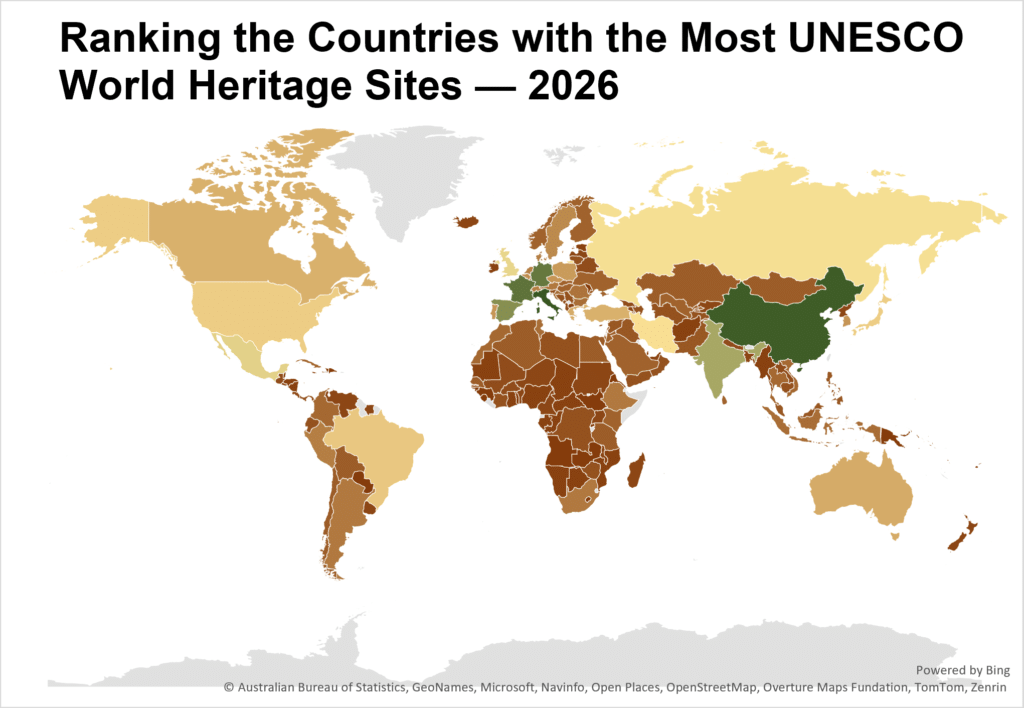
Which Countries Have the Most UNESCO World Heritage Sites in 2026?
| Rank | Country | UNESCO World Heritage Sites |
|---|---|---|
| 1 | Italy | 62 |
| 2 | China | 61 |
| 3 | France | 56 |
| 4 | Germany | 55 |
| 5 | Spain | 50 |
| 6 | India | 45 |
| 7 | Mexico | 36 |
| 8 | United Kingdom | 35 |
| 9 | Russia | 33 |
| 10 | Iran | 30 |
| 11 | Japan | 27 |
| 12 | United States | 27 |
| 13 | Brazil | 26 |
| 14 | Canada | 22 |
| 15 | Türkiye | 22 |
| 16 | Australia | 21 |
| 17 | Greece | 21 |
| 18 | Poland | 18 |
| 19 | Czechia | 17 |
| 20 | Portugal | 17 |
| 21 | South Korea | 17 |
| 22 | Belgium | 16 |
| 23 | Sweden | 15 |
| 24 | Denmark | 13 |
| 25 | Netherlands | 13 |
| 26 | Peru | 13 |
| 27 | Switzerland | 13 |
| 28 | Argentina | 12 |
| 29 | Austria | 12 |
| 30 | Ethiopia | 12 |
| 31 | South Africa | 12 |
| 32 | Romania | 11 |
| 33 | Bulgaria | 10 |
| 34 | Croatia | 10 |
| 35 | Indonesia | 10 |
| 36 | Tunisia | 10 |
| 37 | Colombia | 9 |
| 38 | Cuba | 9 |
| 39 | Israel | 9 |
| 40 | Morocco | 9 |
| 41 | Thailand | 9 |
| 42 | Vietnam | 9 |
| 43 | Finland | 8 |
| 44 | Hungary | 8 |
| 45 | Jordan | 8 |
| 46 | Kenya | 8 |
| 47 | Norway | 8 |
| 48 | Saudi Arabia | 8 |
| 49 | Slovakia | 8 |
| 50 | Sri Lanka | 8 |
| 51 | Ukraine | 8 |
| 52 | Uzbekistan | 8 |
| 53 | Algeria | 7 |
| 54 | Bolivia | 7 |
| 55 | Chile | 7 |
| 56 | Egypt | 7 |
| 57 | Kazakhstan | 7 |
| 58 | Lebanon | 7 |
| 59 | Mongolia | 7 |
| 60 | Senegal | 7 |
| 61 | Tanzania | 7 |
| 62 | Iraq | 6 |
| 63 | Malaysia | 6 |
| 64 | Pakistan | 6 |
| 65 | Palestine | 6 |
| 66 | Philippines | 6 |
| 67 | Syria | 6 |
| 68 | Azerbaijan | 5 |
| 69 | Bosnia and Herzegovina | 5 |
| 70 | Cambodia | 5 |
| 71 | Côte d’Ivoire | 5 |
| 72 | Democratic Republic of the Congo | 5 |
| 73 | Ecuador | 5 |
| 74 | Libya | 5 |
| 75 | Lithuania | 5 |
| 76 | Oman | 5 |
| 77 | Panama | 5 |
| 78 | Serbia | 5 |
| 79 | Slovenia | 5 |
| 80 | Tajikistan | 5 |
| 81 | Turkmenistan | 5 |
| 82 | Yemen | 5 |
| 83 | Zimbabwe | 5 |
| 84 | Albania | 4 |
| 85 | Belarus | 4 |
| 86 | Burkina Faso | 4 |
| 87 | Costa Rica | 4 |
| 88 | Georgia | 4 |
| 89 | Guatemala | 4 |
| 90 | Laos | 4 |
| 91 | Mali | 4 |
| 92 | Montenegro | 4 |
| 93 | Nepal | 4 |
| 94 | Armenia | 3 |
| 95 | Bahrain | 3 |
| 96 | Bangladesh | 3 |
| 97 | Benin | 3 |
| 98 | Cameroon | 3 |
| 99 | Cyprus | 3 |
| 100 | Iceland | 3 |
| 101 | Kyrgyzstan | 3 |
| 102 | Latvia | 3 |
| 103 | Madagascar | 3 |
| 104 | Malawi | 3 |
| 105 | Malta | 3 |
| 106 | New Zealand | 3 |
| 107 | Niger | 3 |
| 108 | North Korea | 3 |
| 109 | Sudan | 3 |
| 110 | Suriname | 3 |
| 111 | Uganda | 3 |
| 112 | United Arab Emirates | 3 |
| 113 | Uruguay | 3 |
| 114 | Venezuela | 3 |
| 115 | Afghanistan | 2 |
| 116 | Botswana | 2 |
| 117 | Central African Republic | 2 |
| 118 | Chad | 2 |
| 119 | Estonia | 2 |
| 120 | Gabon | 2 |
| 121 | Gambia | 2 |
| 122 | Ghana | 2 |
| 123 | Holy See | 2 |
| 124 | Honduras | 2 |
| 125 | Ireland | 2 |
| 126 | Jamaica | 2 |
| 127 | Mauritania | 2 |
| 128 | Mauritius | 2 |
| 129 | Mozambique | 2 |
| 130 | Myanmar | 2 |
| 131 | Namibia | 2 |
| 132 | Nicaragua | 2 |
| 133 | Nigeria | 2 |
| 134 | North Macedonia | 2 |
| 135 | Republic of the Congo | 2 |
| 136 | Rwanda | 2 |
| 137 | Seychelles | 2 |
| 138 | Andorra | 1 |
| 139 | Angola | 1 |
| 140 | Antigua and Barbuda | 1 |
| 141 | Barbados | 1 |
| 142 | Belize | 1 |
| 143 | Cabo Verde | 1 |
| 144 | Comoros | 1 |
| 145 | Dominica | 1 |
| 146 | Dominican Republic | 1 |
| 147 | El Salvador | 1 |
| 148 | Eritrea | 1 |
| 149 | Fiji | 1 |
| 150 | Guinea | 1 |
| 151 | Guinea-Bissau | 1 |
| 152 | Haiti | 1 |
| 153 | Kiribati | 1 |
| 154 | Lesotho | 1 |
| 155 | Luxembourg | 1 |
| 156 | Marshall Islands | 1 |
| 157 | Micronesia | 1 |
| 158 | Moldova | 1 |
| 159 | Palau | 1 |
| 160 | Papua New Guinea | 1 |
| 161 | Paraguay | 1 |
| 162 | Qatar | 1 |
| 163 | Saint Kitts and Nevis | 1 |
| 164 | Saint Lucia | 1 |
| 165 | San Marino | 1 |
| 166 | Sierra Leone | 1 |
| 167 | Singapore | 1 |
| 168 | Solomon Islands | 1 |
| 169 | South Sudan | 1 |
| 170 | São Tomé and Príncipe | 1 |
| 171 | Togo | 1 |
| 172 | Vanuatu | 1 |
| 173 | Zambia | 1 |
Subscribe to our $1 newsletter to get new Data and Maps from around the world on various different topics every month. Click here now to join.
What Is a UNESCO World Heritage Site?
UNESCO sites are cultural, natural or mixed places that have been identified as having Outstanding Universal Value. In simple terms, a UNESCO World Heritage Site matters not only to the local community but also to people all over the world.
The idea comes from the 1972 Convention Concerning the Protection of the World Cultural and Natural Heritage. This treaty asks the signatory governments to find, protect, preserve and pass on heritage of outstanding value to future generations.
It is not simply an award for a place or a location that attracts many tourists. To earn UNESCO recognition, a UNESCO site must meet at least one of the ten selection criteria or the conditions set out for specific criteria and must have enough authenticity or integrity as required.
The World Heritage List contains three principal categories:
Cultural Heritage: The Record of Human Civilisation
Cultural Heritage includes monuments, historic buildings, archaeological sites, historic towns, cultural landscapes and other places that are culturally important.
Cultural Heritage shows what a society could do to build houses, organize trade, settle, express religious beliefs and create a style of art.
Among these cultural Heritage are architectural wonders. Others are living testimony of societies, political systems, technological progress or intercultural conflicts. Remember, not all cultural property sites are monuments. A full landscape and urban space can qualify if their past and culture are worthy for UNESCO.
Natural Heritage: The Value of the Living Planet
Natural Heritage are places that are believed to have geological, ecological or biological importance. Natural Heritage include forests, mountain systems, wetlands, islands, coral reefs, deserts and many other ecosystems.
Some natural heritage contain species or habitats while other natural heritage show important parts of Earth’s geological past or spectacular natural events.
Natural heritage recognition also brings attention to the need for conservation. A natural heritage site might contain ecosystems that are hard to replace once they are damaged or destroyed.
Mixed Heritage: Where Nature and Culture Meet
These mixed Heritage satisfy both natural and cultural requirements. It is interesting how communities of humans and nature can interact and influence each other for decades.
A landscape can hold ecological significance and still show signs of human habitation, traditional land use or spiritual significance.
Based on post-2026 World Heritage Committee data provided by UNESCO, there are 1,273 sites in total: 991 on cultural, 240 as natural and 42 that are mixed sites. Culture sites therefore dominate a list of recognised sites.
Why Do Some Countries Have More UNESCO World Heritage Sites?
The Scale and Diversity of Historical Heritage
Historic settlements, archaeological landscapes, sites, monuments and cultural traditions may broadened the scope for nomination by many.
Sites such as trading posts, government centres, places of worship or technological centres might hold traces from many epochs.
The variety of evidence matters. A set of properties with different architectural styles, historical periods and cultural traditions will create a larger variety of potential nominations.
Natural and Geographical Variety
Possibility to widen the amount of natural heritage properties due to geographical diversity.
A region that includes ecological zones, geological areas, mountain ranges, coastal areas and habitats could have more than one site of international significance for conservation.
Size does not be all and end all. An island may be quite tiny but can have an ecosystem that is of outstanding importance to the whole world just as a extensive territory may have very few properties that satisfy the UNESCO criteria.
Conservation Institutions and Funding
The process of nominating a site to become a World Heritage site is a demanding one. It needs research, recording, setting boundaries, legal protection, planning, management and gathering evidence to prove that a World Heritage site fits the criteria.
Countries that already have heritage organizations, trained staff, conservation money and long‑term management and planning systems may be better prepared to expect and support nominations.
Being recognized gives both duties and rights. After all, the World Heritage site is inscribed on it, must keep its Universal Value forever.
International Cooperation
Some sites go beyond borders. Transboundary sites prove that heritage does not always stay within borders.
Mountain ecosystem, forest, archaeological landscape or historic route may be spread across countries. Protection of such sites can involve collaboration between governments, conservation organisations and local communities. Such cooperation may also enhance the representation of heritage inscribed on the World Heritage List.
Conclusion: A Ranking of Recognition, Not a Measure of Human Heritage
The 2026 Ranking of countries with the most UNESCO World Heritage Sites shows that the world have highly uneven distributed heritage sites.
The real story behind these numbers is not how many UNESCO World Heritage Sites a country has. The real story is that there are different kinds of UNESCO World Heritage Sites. These are places that we, all of humanity choose to honor and protect.
The World Heritage List brings together the best of our world’s culture and natural heritage. It shows how natural and cultural heritage can go beyond different frontiers, connecting communities that are separated by distance, language or history.
A country that has dozens of listed properties has a variety of heritage that is important to the whole world. A country with one property may still have a single site that is of outstanding universal value.
In the end, the true importance of this legacy cannot be measured by the number of places on the list.
The real achievement is in protecting these places, keeping alive the stories they tell and making sure that we leave something behind for our children—not photos and books but the places themselves.
Subscribe to our $1 newsletter to get new Data and Maps from around the world on various different topics every month. Click here now to join.
Sources and Methodology
Primary source: UNESCO World Heritage Centre — World Heritage List
Additional data reference: UNESCO Heritage Tracker — Sites by Country
Metric: Total number of UNESCO World Heritage properties attributed to each country.
Methodology:
- Counted cultural, natural and mixed World Heritage properties.
- Ranked countries from the highest number of properties to the lowest.
- Counted transboundary properties for every participating country, following UNESCO’s country-attribution approach.
- Excluded countries without any inscribed World Heritage properties.
- Used the published country totals without estimating missing values.