
Top 25 Best-Selling Car Brands in the World 2025–2026: Global Sales Ranking
The global car industry is one of the most competitive industries in the world. Around the world, millions of cars are purchased every year, from inexpensive hatchbacks and family cars to high‑end SUVs, electric cars and trucks. Cars are everywhere.
But which company sells the most cars in the world?
Toyota remains the biggest car brand worldwide and Toyota is far ahead of other Automobile makers but competition is growing. Volkswagen is still a major player and Chinese brands BYD, Geely, Chery and Changan are also gaining ground in the global car market.
The rise of Electric cars has changed the global Automobile scene. Now brands that were unknown globally are fighting for market share against established makers.
Using 2025 sales data, Toyota sold 9.65 million cars while Volkswagen sold 4.73 million and BYD sold 4.60 million.
The gap between Toyota and the next best seller shows how tough it is to stay on top when technology, price, supply and demand are constantly changing.
Let me show you the top 25 carmakers by their worldwide sales numbers.
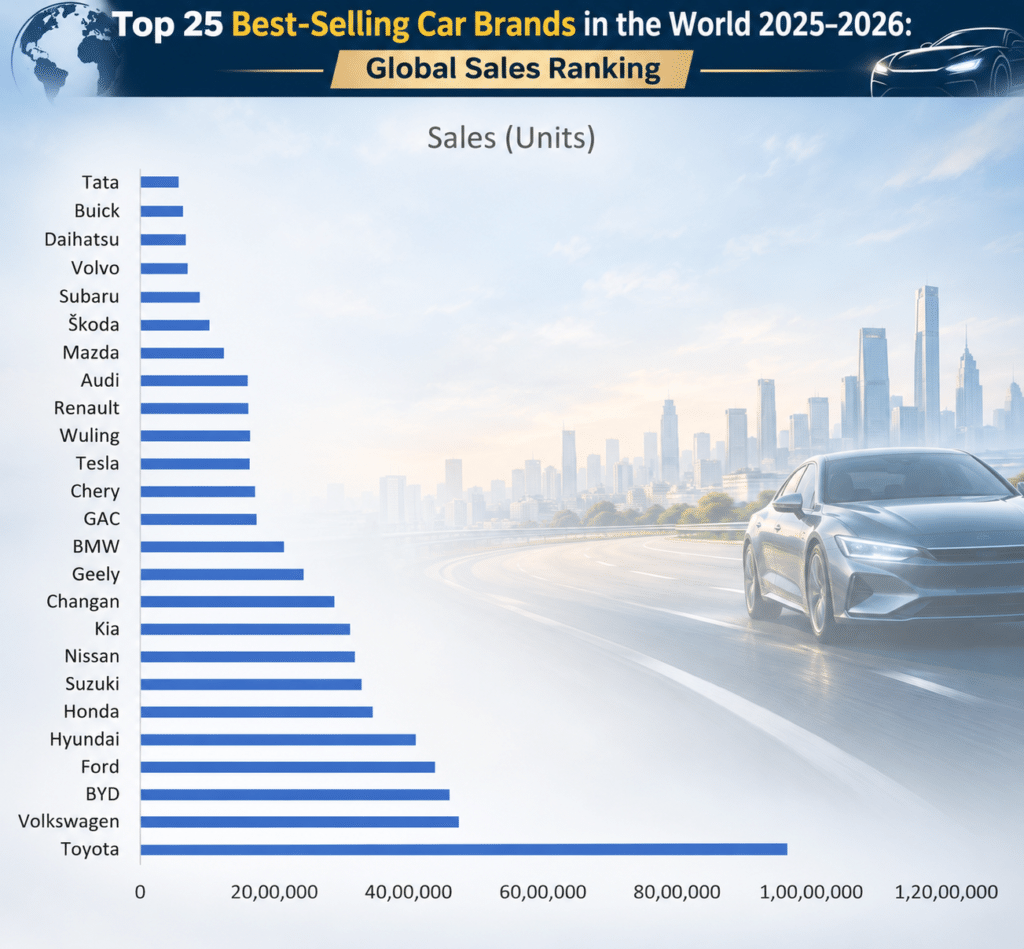
Which Are the 25 Best-Selling Car Brands in the World?
| Rank | Brand | Sales (Units) |
|---|---|---|
| 1 | Toyota | 9,654,576 |
| 2 | Volkswagen | 4,730,600 |
| 3 | BYD | 4,602,436 |
| 4 | Ford | 4,395,000 |
| 5 | Hyundai | 4,108,605 |
| 6 | Honda | 3,460,000 |
| 7 | Suzuki | 3,295,013 |
| 8 | Nissan | 3,202,137 |
| 9 | Kia | 3,135,803 |
| 10 | Changan | 2,913,042 |
| 11 | Geely | 2,450,000 |
| 12 | BMW | 2,169,761 |
| 13 | GAC | 1,721,489 |
| 14 | Chery | 1,700,940 |
| 15 | Tesla | 1,636,129 |
| 16 | Wuling | 1,635,100 |
| 17 | Renault | 1,628,030 |
| 18 | Audi | 1,623,600 |
| 19 | Mazda | 1,256,215 |
| 20 | Škoda | 1,043,900 |
| 21 | Subaru | 896,000 |
| 22 | Volvo | 710,042 |
| 23 | Daihatsu | 675,285 |
| 24 | Buick | 634,884 |
| 25 | Tata | 578,771 |
Subscribe to our $1 newsletter to get new Data and Maps from around the world on various different topics every month. Click here now to join.
What Does the Global Car Sales Ranking Tell Us?
This ranking shows some huge changes happening in the global car industry.
Toyota’s Lead Is Still Very Hard to Catch Up With
It’s impressive how Toyota is doing because it sells most cars by itself than the next two companies combined. This is because of years of making cars, people trusting the brand and having a wide network around the world.
Even though more and more other companies are trying to use new technology Toyota still has the benefit of having a wide range of products that fit different markets and what customers want.
Chinese Manufacturers Are Becoming Global Competitors
The biggest change perhaps is the rising number of Chinese automakers. BYD, Changan, Geely, GAC, Chery and Wuling all show up in the Top 25.
Their growing presence shows clearly that China’s automotive industry is doing more than just making cars for China.
Chinese manufacturers are pushing forward with vehicles, batteries, smart pricing and rapid product development.
BYDs role is especially important because it has become one of the world’s efficient producers of new energy automobiles.
Electric Vehicles Are Reshaping the Industry
Electric mobility is changing how automobile manufacturers compete.
Battery‑electric automobiles are the foundation of business models for automakers like Tesla and BYD. Many manufacturers invest billions of dollars into Electric vehicles (BEV).
The total global figure of Electric cars sold in 2025 was over 20 million making up around a quarter of all new cars sold worldwide.
Electric cars is acting as one of the biggest changes for an industry that relied on petrol and diesel engines for over a hundred years.
Japanese Manufacturers Continue to Have a Strong Presence
Suzuki, Honda, Toyota, Mazda, Nissan, Subaru and Daihatsu reflect the never ending significance of Japanese car engineering.
The factors behind their achievement have been manufacturing efficiency, reliability, fuel economy and international growth. Japanese manufacturers are still among the important players in the age of electric mobility.
European Manufacturers Remain Strong in Premium and Passenger Vehicles
Volkswagen demonstrate Europe’s continuing importance in global Automobile manufacturers in Europe.
European producers have built their reputation on engineering excellence, luxury vehicles, safety technology and high-end mobility solutions.
Still they are facing growing pressure from electric vehicle makers. These companies are pushing hard on price, production capacity and advanced technology. European brands must now compete aggressively in all these areas to stay relevant.
Conclusion
The Global Automobile market has seen the most impactful transformations in history.
Toyota continues to dominate sales showing how important reliable cars, good manufacturing skills and worldwide customer trust are. VW remains strong. While BYD has become one of the biggest players in the EV revolution.
At the same time, companies such as Honda, Suzuki, Hyundai, Nissan and Ford keep running to serve their customers worldwide with cars.
Another bigger long‑term trend is the rise of Chinese car manufacturers. BYD, Changan, Geely and Chery challenge the established car makers by offering cheaper cars, electric cars and fast technology progress.
Selling millions of cars is one way to judge success. The future of the auto industry will also focus on batteries, driver‑free cars, software, cheap cars, Electric cars and ability to adapt to changes, car makers make to keep customers happy.
It is clear that the fight to lead the world car market is no longer for the old giants of the automotive sector. A new generation of car manufacturers has arrived.
Subscribe to our $1 newsletter to get new Data and Maps from around the world on various different topics every month. Click here now to join.
Sources
- RoadGenius – Worldwide Car Sales Statistics
- Focus2Move – Global Brand Ranking 2025
- Volkswagen Annual Report 2025
- CarExpert – 2025 Global Automotive Sales
Methodology
- Reference year: January–December 2025.
- Ranking is based on reported worldwide vehicle sales, deliveries or shipments.
- Individual brands are separated wherever the available reporting permits.
- Figures are arranged in descending numerical order.
- Approximate figures are retained where exact comparable figures are unavailable.
- Brands without usable 2025 figures are excluded.
- Parent-company and individual-brand reporting differences are acknowledged.