
Top 10 Most Expensive Megaprojects in the World 2026: Biggest Investments Ranked
The world’s biggest infrastructure plans are no longer brick and mortar. Governments are now pouring hundreds of billions of dollars into high‑tech cities, fresh energy sources, fast train lines, giant hydropower plants and of course science labs. These projects aim to turn the tide in economies, strengthen how we connect, boost energy, safety and change the way we live and work.
Some of these projects are so huge that their cost alone is larger than the GDP of some tiny countries. For example Saudi Arabia’s NEOM, China’s Yarlung Zangbo Hydropower Project and the United States’ California High‑Speed Rail all set extraordinary financial benchmarks.
What makes these projects especially intriguing is the diversity. Some want to build a city from scratch. Others promise cleaner power or links between far‑away places. Some focus on tech that could change humanity.
Which projects need the most money?
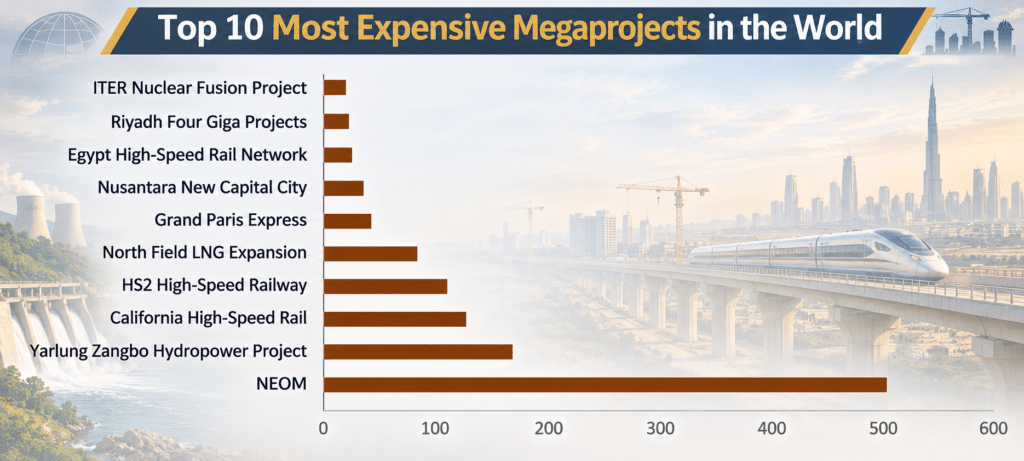
In this VizAtlas article, we list the 10 expensive megaprojects in the world for 2026. We give details on the projected investment, the location, the goal and the global economic impact. We also rank the projects that’re already in progress and those that are still planned and we show the investment in dollars in the comparison table below.
What Are the 10 Most Expensive Megaprojects in the World in 2026?
| Rank | Megaproject | Country | Estimated Investment |
|---|---|---|---|
| 1 | NEOM | Saudi Arabia | $500 billion (initial ambition) |
| 2 | Yarlung Zangbo Hydropower Project | China | $168 billion |
| 3 | California High-Speed Rail | USA | $126 billion |
| 4 | HS2 High-Speed Railway | United Kingdom | $110–130 billion |
| 5 | North Field LNG Expansion | Qatar | $82.5 billion |
| 6 | Grand Paris Express | France | $40–42 billion |
| 7 | Nusantara New Capital City | Indonesia | $35 billion (planned investment) |
| 8 | Egypt High-Speed Rail Network | Egypt | Approximately $23 billion |
| 9 | Riyadh Four Giga Projects | Saudi Arabia | $23 billion |
| 10 | ITER Nuclear Fusion Project | France (international collaboration) | More than $20 billion (broad historical estimates) |
NEOM – Saudi Arabia ($500 Billion)
One of the most bold urban planning projects ever shown in Saudi Arabia is the billion-dollar city, NEOM. As part of the Vision 2030 plan, which was created to help the country stop depending much on oil money. NEOM was first planned as a $500 billion investment.
NEOM is a city that will cross the border in the northwestern part of Saudi Arabia. It was meant to be a city with technology and new economic industries. It will include cities, connected industries and modern infrastructure.
The Line might have been the amazing part of it. It was first thought of as a 170km city with two mirror buildings. Designed to hold millions of people. It was said that the city would use few roads or personal cars.
Oxagon was meant to be an area for industry and moving goods. Trojena was meant to be a place in the mountains for visitors. Sindalah was meant to be an island for luxury.
The project is expected to help companies, investors, visitors and technology firms. It will also create ways to make money.
Neom has had money problems, building issues and changes in what they want to do. Saudi Arabia has changed the plans and the time for some projects like The Line and Trojena. The original $500bn goal for investment should now be seen as the amount needed.
With these problems, NEOM is still considered one of the biggest and most daring city projects, in the world.
Yarlung Zangbo Hydropower Project – China ($168 Billion)
The Yarlung Zangbo Hydropower Project in China is one of the investment projects in energy infrastructure ever made.
Located in the lower reaches of the Yarlung Zangbo River in Tibet, the project will construct a chain of five hydropower stations also known as a cascade. The total planned investment is around 1.2 trillion yuan, which’s about 167.8 billion US dollars.
Construction was officially announced in July 2025. It is among the most significant energy projects currently under way in the world.
The river has an elevation enormous difference, which gives the project an enormous capacity to generate electricity. The expected yearly output is 300 billion kilowatt-hours.
That amount of electricity is massive. It could power all the industrial centres in China and meet a large portion of the country’s energy needs.
This is especially important because China is trying to increase its electricity generating capacity. At the same time, China’s electricity demands are rising due to rapid manufacturing growth, urbanisation and new technologies.
The location of the project however brings up concerns beyond China’s borders. The Yarlung Zangbo River flows into India and becomes the Brahmaputra. It continues into Bangladesh. Because of this, the project has raised issues about water security in downstream countries. It has also sparked debates over protection and regional cooperation.
If the Yarlung Zangbo Hydropower Project is successfully completed, it could become one of the most influential energy projects of the 21st century.
California High-Speed Rail – United States ($126 Billion)
California High-Speed Rail is expected to be the largest transportation investment in American history. Its main goal is to connect cities in California with a high-speed train system. The original idea was to connect Los Angeles and San Francisco as well as other major cities.
This project wants to provide a way to travel that’s faster than flying or driving and at the same time, reduce traffic and pollution from transportation. Work on the project will mostly happen in the Central Valley of California which is one of the biggest farming and business areas in the state.
The line is designed for trains that can go up to 350 kilometers per hour on the suitable parts of the track.
The project has had problems with costs and schedules. The price of building has gone up a lot since the project first started and the plan for the track has changed.
The first part of the plan is expected to cost $126 billion in building costs according to the states Draft 2026 Business Plan. This number is not the same as the money already spent – it was calculated based on the plan and new ideas.
If built, the high-speed rail line could change how people travel between cities in the state of California between busy cities. Its benefits could also play a role in the national conversation about whether to make similar investments in high-speed rail across the country.
HS2 High-Speed Railway – United Kingdom ($110–130 Billion)
One of the most expensive megaprojects in the world is the United Kingdom’s High Speed 2 (HS2) railway project.
HS2 was initially scheduled to link London to Birmingham, Manchester and several other large northern cities. The goal was to increase rail capacity, decrease travel times and boost connectivity for significant regions. The project was meant to run high speed trains reaching around 360 km/h.
Nonetheless, a large part of the geographical scope has been lost: the Birmingham-to-Manchester extension was abandoned in 2023; the only remaining stretch has thus become the principal section from London to Birmingham.
Moreover the project has been subjected to repeated schedules changes, construction cost escalation, engineering non-feasibility and acquisition issues.
In May 2026, the UK Department for Transport announced a revised estimated cost range of £87.7 billion to £102.7 billion. This is approximately equivalent to the US$110-130 billion range used in the comparison table depending on exchange rate and the basis of the dollar/pound comparison.
Despite these challenges, the strategic importance for HS2 and Britain’s railway remains strong.
The project hopes to increase capacity for passengers and create links between economic centres. The ultimate benefits of the project will require the control of costs as well as the completion of further construction work.
North Field LNG Expansion – Qatar ($82.5 Billion)
Qatar is dramatically raising its natural gas production capacity by working on the North Field LNG Expansion Project. One of the world’s natural gas fields, the North Field is an extension of the field in Iran, where it is called South Pars.
Qatar wants to boost its liquefied natural gas export capacity and strengthen its position in the world energy market by developing this programme. This project will unfold in multiple phases covering North Field East, North Field South and later the West Field expansion.
When finished, this project should lift Qatar’s LNG capacity from the 77 million tonnes to 142 million tonnes each year by the end of the decade, according to the project timeline.
About $82.5 billion is already planned for investment with Qatar Energy covering a part of the cost. Foreign energy companies such as Exxon Mobil, Shell, Total Energies, Eni and Conoco Phillips are handling different parts of the programme.
This project is very important because LNG has become a part of global energy trade.
Qatar says that raising its production capacity will allow it to meet growing demand in Asia and Europe and will also strengthen Qatar’s energy connections. It also shows that the infrastructure for gas continues to attract huge investment from global finance even as the world moves toward greener energy sources.
Grand Paris Express – France ($40–42 Billion)
The Grand Paris Express is the largest urban project in Europe. The Grand Paris Express aims to change transport around Paris by building 200 kilometres of new automated metro lines and many new stations.
The Grand Paris Express expansion is very different from a railway project. It is less about linking the city centre to the outskirts and more about connecting one suburb to another.
The Grand Paris Express includes four metro lines and extensions to existing lines 15, 16 17 and 18.
When the Grand Paris Express is finished, it should greatly improve connectivity across the Île-de-France region. It will offer an alternative to cars and make travelling to work easier for millions of residents.
The Grand Paris Express will also boost growth by giving people easier access to jobs, schools, airports and shopping centres.
The estimated cost of the Grand Paris Express has risen a lot since it was first announced. Several sources say the cost is about €36.1 billion according to government and parliamentary reports. If you add investment figures and convert to dollars the cost would be about $40–42 billion.
The Grand Paris Express infrastructure is so large that it can redefine the metropolitan area.
Nusantara New Capital City – Indonesia ($35 Billion)
The plan of Indonesia’s Nusantara is an effort to move the country’s capital. This plan of Indonesia’s Nusantara will build the capital in East Kalimantan on the island of Borneo. The plan of Indonesia’s Nusantara will eventually replace Jakarta as the administrative centre of Indonesia.
The construction of a capital city was intended to address the worst challenges of Jakarta. These include traffic congestion, land subsidence, flooding, population density and concerns over the environment.
Nusantara is planned to be an up-to-date and environmentally sustainable city. Development of the Nusantara area comprise government buildings, housing, transportation systems, shopping districts, public service programs and all necessary public works.
The original investment estimate is about $35 billion but that must be regarded as high-level planned development costs, not a definite capital budget. Meanwhile the Indonesian government has also formulated a development plan with public funding, private investment and public‑private partnership. Updated planning documents have adjusted the amount of funding needed for each stage of development so it is important to differentiate between the project estimate and allocations in existing budgets.
The project is expected to generate spillover effects on development outside Java, upgrade regional infrastructure and establish a new capital city. Raising enough private investment and creating a viable urban economy will also be another challenge.
Egypt High-Speed Rail Network – Egypt ($23 Billion)
Egypt is currently working on one of the important railway modernisation projects in Africa and the Middle East. The country wants its high-speed rail system to cover an area of 2,000 kilometres and connect 60 cities with a strong railway network.
The project is meant for moving passengers and goods. It connects three railway lines. A key part of the system will run from Ain Sokhna on the Red Sea to the Mediterranean. This will create a railway link across areas that are important for business and manufacturing.
The network is being built with the help of Siemens Mobility. It also includes construction companies like Orascom Construction and Arab Contractors. The railway network will include speed trains, regional trains, freight locomotives, railway infrastructure, depots and maintenance plants.
The total cost of the project is expected to be about EGP 360 billion ($ 23 billion based on the exchange rate when the estimate was made) according to the State Information Service of Egypt.
The project will help improve connections within the country, make freight transportation better and help Egypt’s economy. It could also make it easier to reach tourism spots like the areas around Luxor and the Red Sea.
For Egypt, this investment is a step in improving Egypt’s transportation system and strengthening Egypt’s role as a centre for logistics in the region.
Riyadh Four Giga Projects – Saudi Arabia ($23 Billion)
Saudi Arabia has again made it to this list with four major projects planned to completely change the city of Riyadh.
These projects started in 2019 are part of the goals of Vision 2030 and together they have received almost $23 billion in funding from the government.
They include:
King Salman Park: This project will become one of the largest urban parks in the world, combining parks and gardens, cultural places, fun areas and entertainment zones.
Green Riyadh: This is a plan to plant around 7.5 million trees across the city to make Riyadh greener and improve the environment.
Sports Boulevard: This is a 135km urban area that has sports and recreation facilities for biking, walking, running and more.
Riyadh Art: A city-wide public art program that will turn the capital into an open-air art spot with installations, artwork and creative activities.
These projects are meant to improve the quality of life for people living there and to make the city more exciting with entertainment, business, sports and hotels for visitors as they also aim to bring in private investment.
While NEOM is a project to create a new area ,these project focus on existing main areas with a lot of people. They are also part of Saudi Arabia’s plan to change the economy and make Riyadh more appealing, to foreign travelers.
ITER Nuclear Fusion Project – France (More Than $20 Billion)
The International Thermonuclear Experimental Reactor – ITER for short – is likely to be one of the most ambitious projects in scientific history. ITER is a collaboration involving seven members: China, the European Union, India, Japan, South Korea, Russia and the United States. It is based in France.
The project is intended to prove that nuclear fusion is an technologically feasible option for large scale power generation.
The energy generated by fusion is produced, when light atomic nuclei fuse together to produce heavier nuclei and enormous quantities of energy. This is the process which drives the Sun.
ITER is being built with a tokamak as its core, a device that contains the plasma through intense magnetic fields. The main experiment goal is 500 MW of fusion power from 50 MW of applied plasma heating power at given conditions.
Nonetheless there is a difference: it is not a power plant, which produces electricity.
Technical difficulties, manufacturing challenges and construction delays have led to a cost increase from the recent estimates.
That number was presumed to be in the 18-20 billion euro range. It’s impossible to boil the total down to a single number that can be directly compared to other projects as each member country pays equipment and services in various currencies.
The amended project timeline sanctioned in 2024. Also the commencement of deuterium-tritium operations is expected from 2039. Despite the problems, ITER is still one of the important scientific experiments humans have ever embarked upon.
Why Are Countries Spending Billions on Megaprojects?
The scale of investment involved in these developments is motivated by a range of political and technological priorities.
- Diversification of sources of wealth: Nations like Saudi Arabia, Indonesia are building cities, tourism, manufacturing and transportation to have other streams of wealth.
- Energy Security: China’s hydropower growth and Qatar’s gas expansion show how nations can build up energy assets to not only future‑proof their economies but also to project power into the global arena.
- Connectivity and transportation: HS2, California High‑Speed Rail and Grand Paris Express are examples of projects designed to enhance connectivity provide access to local areas and facilitate shorter travel times.
- Leadership: ITER is an investment in scientific research, which could have implications for future energy technologies as well as providing participating nations with access to engineering expertise.
- Urban growth: Urbanisation pressure on demand for housing, transportation, utilities, healthcare and public space is growing. New cities and urban infrastructure investments are efforts to meet them.
Yet huge investment does not lead to success. A number of megaprojects are plagued by delays, excessive costs, political alterations, a lack of investment and so on. The sustainability of these projects is determined by the returns of investments.
Conclusion
The Top 10 Most Expensive Megaprojects list show efforts by governments and international organisations to plan the future with mega investments.
From Saudi Arabia’s chase into futurism with its NEOM megacity project to China’s titanic hydroelectric power plant. These examples illustrate the wide range of ways in which nations are seeking to break economic bottlenecks.
The interesting thing about this ranking is that it’s not the case that all megaprojects mean the same thing. Building a capital city, a high‑speed railway, a gas expansion and an experimental fusion reactor, each have very different aims but all demand huge sums of money and specialised engineering work.
Investment figures alone will not measure their impact. If the projects will deliver their aims, it will be down to their execution on time within budget in a responsible manner and generating quantified economic benefits.
We will witness over the decades, which of these giant endeavors prove to be worthwhile human construct and which ones are to be remembered as warnings of the financial hazards of constructing on such an extraordinary scale.