
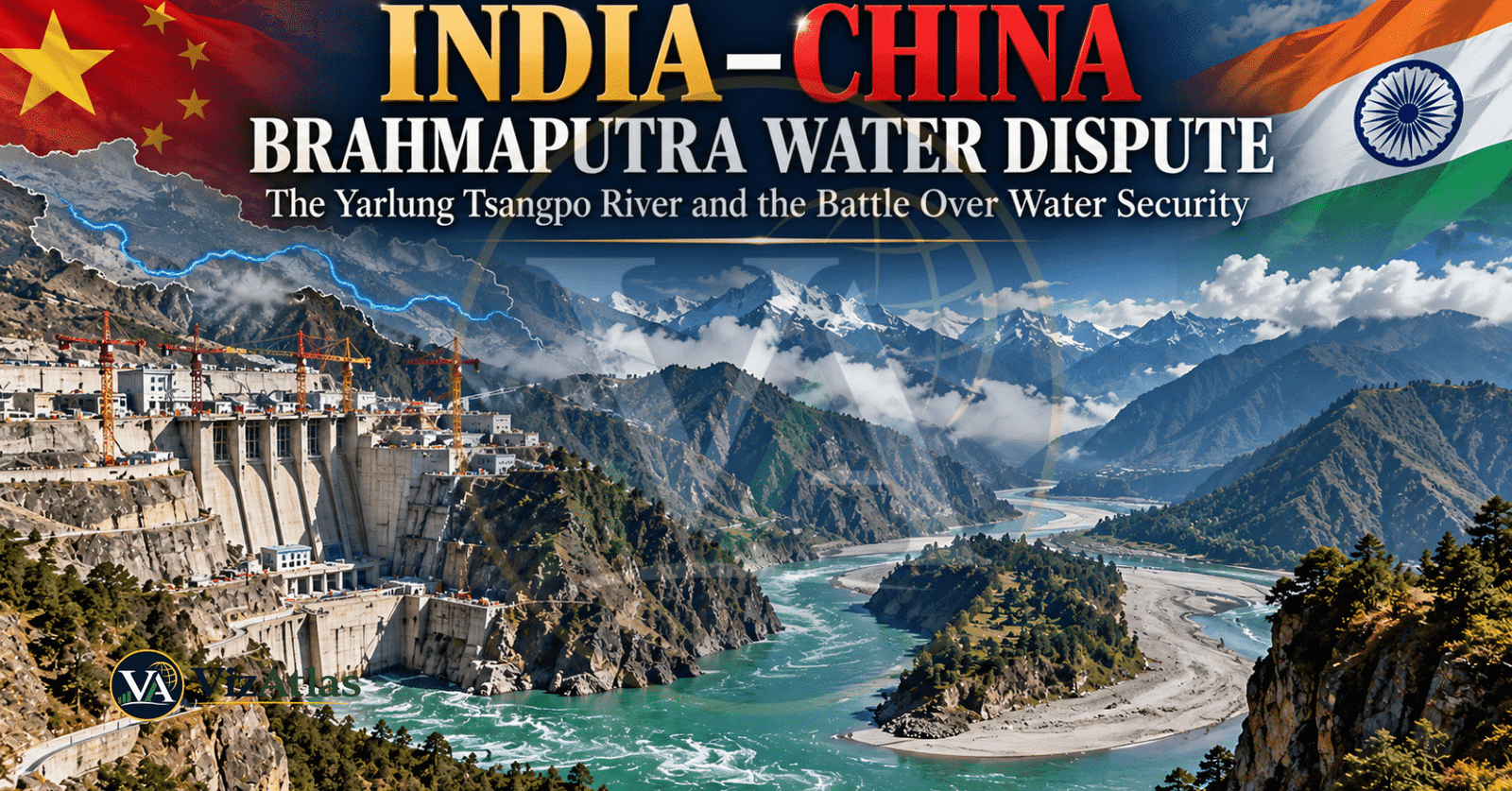
China–India–Bangladesh Brahmaputra Water Dispute: Yarlung Tsangpo, China’s Mega-Dam & Water Security
Brahmaputra is not just a river. The Brahmaputra is an artery for Tibet, India and Bangladesh connecting some of Asia’s great ecological and agricultural zones. It is also involved in one of Asia’s most fragile water conflicts.
The river is called the Yarlung Tsangpo as it flows eastward through Tibet and China across the Tibetan Plateau then turns southward around the Himalayas and enters India. After entering Arunachal Pradesh, the river is called the Siang. When it meets its largest tributaries it becomes the Brahmaputra in Assam. The river then enters Bangladesh as the Jamuna.
This geography creates a strategic problem: China controls the upper river basin while India and Bangladesh use the lower part.
It is more complicated than saying China is “Controlling India’s water.” A large part of the Brahmaputra’s water comes from rain and catchment areas right after the river enters India. Still this does not erase China’s advantage because China sits upstream. The dams, impoundments and barrages in Tibet can change the timing of flows and sediment as well as flooding and hydrological data.
The situation has become more urgent after China approved a dam project on the lower reaches of the Yarlung Tsangpo River in December 2024 and began work in July 2025. It will become the world’s largest hydropower project when finished.
For India— mainly for Arunachal Pradesh and Assam—this issue is larger, than power generation. It concerns water security, flood risk, ecology, agriculture, strategic security and the changing India‑China relationship.
Where Does the Brahmaputra Actually Begin?
The river starts on the Tibetan Plateau (called as the Yarlung Tsangpo or Yarlung Zangbo).
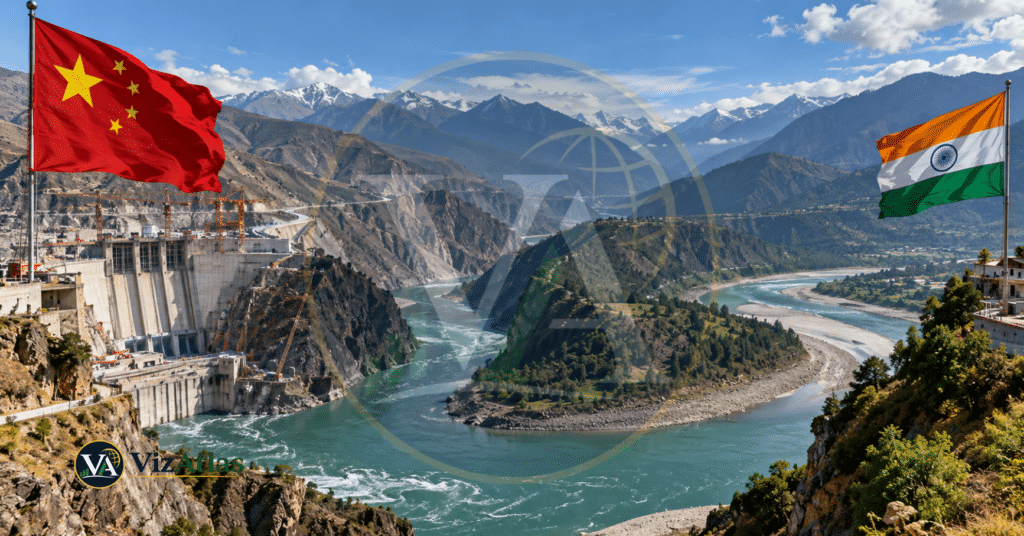
It moves east across Tibet until it reaches one of the amazing sights, in the whole Himalayan area: the Great Bend.
The Brahmaputra makes a U-shaped loop here then it heads south again cutting through the Himalaya and going into Indian Arunachal Pradesh. It is called the Siang in Arunachal. In Assam, the river is called the Brahmaputra.
It continues through Bangladesh. The Jamuna is what the Brahmaputra is known as when it gets to Bangladesh.
This makes this river a transboundary river, a river system that crosses the borders of many countries.
The Brahmaputra catchment is very complicated because water comes into the river from various sources. Even though the river begins in Tibet, a lot of water is added once it goes past the part of the Himalayas from rain and other streams. This is one reason why ideas that China can simply stop the Brahmaputra are not true.
This does not mean that everything upstream is not important.
The timing and amount of water released from the beginning of the river, the movement of rocks and sand, flood data and the availability of river information can still have a big impact downstream.
Why Is the Brahmaputra Important to India?
The Brahmaputra is very important in the Arunachal Pradesh and Assam regions.
In Assam, the river and its tributaries help people in farming, nature and the power generation from water. In Arunachal Pradesh, the river and its smaller tributaries are very important for the people, the economy, farming and nature.
The water in this area helps farming and fishing and the areas next to the river floodplains have some of the most fertile soil.
At the same time, the river is known for big and damaging floods. This creates a problem for Assam: the same river brings money and also a real danger from nature.
Another thing to think about is the amount of sediment it carries. The sediment it brings helps in the formation and maintenance of floodplains next to the river and the small islands in the Brahmaputra area and other places.
The result of this is that changing the rivers natural water flow and the amount of sediment it carries can affect more than the amount of water.
This is why India is worried not about taking water away by China but also about how building Dams upriver can alter the river’s natural course.
Why Does China Want to Build Dams on the Yarlung Tsangpo?
The Yarlung Tsangpo river has a lot of hydropower potential.
The Yarlung Tsangpo river drop sharply from the Tibetan plateau. In the Great Bend area, the Yarlung Tsangpo runs through a canyon system with a huge altitude difference.
For China the Yarlung Tsangpo is great news because China can produce huge amounts of Hydroelectric Power.
Another significant reason is China’s energy policies. China has increased its energy usage largely to wean itself off fossil fuels and lower its climate emissions.
The Chinese government says that the Yarlung Tsangpo project is not a water‑control project but a clean‑energy and economic‑development project. China has insisted that the Yarlung Tsangpo project will have no impacts on downstream countries and that ecological preservation and engineering safety are the priorities.
Another aspect of the argument is that hydropower stations produce electricity without taking water out of the river as far as irrigation withdrawals do. That distinction is important.
A Hydroelectric power plant can generate power from the flow and then put the water back, into the river system. However, A large dam or a cascade of projects can alter the timing of flows, sediment and conditions of the river.
This is where the root of much of the disagreement between the China, India and Bangladesh is
The Mega Yarlung Tsangpo Hydropower Project
The biggest development in this controversy occurred in December 2024 when China approved a large-scale hydropower project downstream of the Yarlung Tsangpo. Construction on the hydropower project officially began in July 2025.
Hydropower project is planned as a cascade of five hydropower stations on the Yarlung Tsangpo. Hydropower project is expected to produce about 300 billion kilowatt‑hours each year and has a reported installed capacity of about 60 gigawatts.
Hydropower project will be far stronger than China’s 22.5‑gigawatt Three Gorges Dam in power‑generation capacity.
Hydropower project sits in the Great Bend area just before the Yarlung Tsangpo turns sharply south toward India. Reuters reports that the cost is about $170 billion. The final cost and engineering plan may change as construction continues.
China has called this hydropower project as one of its clean‑energy initiatives. India looks at this hydropower project from a very different perspective. New Delhi has long told Beijing that upstream activities on the Yarlung Tsangpo should not harm the interests of both the states.
The Indian government also says the work on this hydropower project is being watched closely and steps are taken to protect the lives and livelihoods of people.
What Exactly Is India & Bangladesh Worried About?
India and Bangladesh concerns are related to several topics:
1. Changes in River Flow
The first concern is that any major infrastructure built upstream may disrupt the natural flow of the river. The project is said to not have an impact on water resources downstream.
India for example has called for transparency when it comes to how the project is designed, the amount of storage, operational rules and the downstream effects.
The real issue is not that China will permanently take the water. It is that large infrastructure can change the timing of when water reaches areas in India and Bangladesh. Timing is very important for a river, like the Brahmaputra, which’s already unpredictable.
2. Floods and Sudden Water Releases
The Brahmaputra basin already has major floods every year.
India is worried because of this. The releases from structures upstream during bad weather or big technical problems can cause heavy damages downstream.
The dam is a very big project. Does all this building have the power to change flooding? China says yes their power projects can even help manage floods.
The project can also be used for stopping disasters and the big changes in water flow that have happened before, said the Yarlung Tsangpo River Control Office in China’s Tibet autonomous region without giving more details.
India’s concern is that the country downstream needs information in order for the structures upstream to make a difference on the river. This makes real-time water data very important.
The Importance of Sediment
One area that often gets ignored in the dispute is sediment. The sediment carried by the Brahmaputra is enormous.
Don’t see sediment as waste. Sediment plays a role in keeping floodplains healthy, maintaining river islands and supporting farmland.
Large dams can block sediment from moving. When the natural flow of sediment is changed significantly effecting downstream river channels, ecosystems and processes may be affected.
Still the effects of the Yarlung Tsangpo project remain unclear. The project is still under construction and the details about how it will operate are not yet available. This is why independent scientific review and open data sharing are so crucial.
Could China “Turn Off” the Brahmaputra?
This is probably the common argument that is simply said but maybe worth more attention. You cannot just stop the Brahmaputra.
A lot of the Brahmaputra’s flow including rain and smaller tributaries on the other side of the Himalayas in India happens after the river has entered the country.
So even a big project in Tibet could not have stopped the river from flowing into Assam and Bangladesh for long.
This does not mean that China mega Dam project does not have any effect.
As a country upstream, China could have an effect on the part of the river, the way water is released, the amount of sediment in the water and the information about the water flow.
So the real problem is more complicated than a “water switch.”
What is at risk? The fight over River water mostly depends on the structures in the area that collects water and unclear sharing of information. No full plan for sharing water across the whole river area.
India and China Do Not Have a Comprehensive Brahmaputra Water-Sharing Treaty
This might be the most significant organizational issue/error.
India and China plan to work on shared rivers but India and China do not have a treaty like India and Pakistan have for the Indus waters. That treaty sets out how river water is shared and how disputes are solved.
Instead, India and China focus more on agreements, exchanging data and diplomacy.
One important body is the Expert-Level Mechanism(ELM) on border rivers, which was founded in 2006. This mechanism deals with problems such as flood-season information, emergency response and development cooperation on other trans-boundary rivers. An official statement from India’s Embassy in Beijing in 2026 says that 16 rounds of ELM meetings have taken place the latest being in New Delhi in April 2025.
India and China also reached agreements about providing flood-season data on the Yarlung Tsangpo/Brahmaputra from China to India.
In the 2013 memorandum, the main focus was the provision of data to India during the flood season. These arrangements are helpful but they can not be a substitute for a water‑sharing treaty.
China’s Position in the Dispute
The Chinese attitude toward the Yarlung Tsangpo project has been to dismiss concerns raised by India. Beijing says that the development of hydropower has been based on engineering studies and that the project will not harm water rights of downstream countries or cause any bad ecological effects.
Chinese officials also claim that the project will help regulate flows and aid flood and disaster management. Another point that Chinese authorities always raise is that the country has the right to carry out infrastructure projects on its soil.
The project is advantageous for Beijing for a number of reasons:
- Massive renewable electricity generation
- Development in Tibet
- Better use of hydropower resources
- Support for China’s carbon-reduction goals
- Greater energy security
- Potential flood-management benefits
Furthermore China says that China will maintain dialogue with downstream countries via existing channels. So fundamentally the disagreement is not simply about what to do about hydropower in China. The major concerns are about the design, operation and communication about these projects toward downstream countries.
Why the Issue Is More Sensitive Because of the India–China Border Dispute
Water and border politics will always be closely connected.
Deep in the south of the river is very close to one of the most geopolitically sensitive areas in the world. India and China have a standing land dispute, most notably over Arunachal Pradesh which Beijing claims as part of “Southern Tibet”.
India refutes the assertion and considers Arunachal Pradesh to be Indian territory.
The two countries also had a serious military clash in 2020 along the Line of Actual Control. Therefore regardless of what China claims, for India everything about the project should be seen from a different perspective.
It is not so much that China would turn the water into a weapon. Instead strategic mistrust turns uncertainty into a security threat.
Secondly if two nations are already engaged in a border dispute then a large infrastructure project upstream of a principal river, in one country will readily raise suspicion.
What Could India Do?
A multipronged approach would probably be needed in India’s response:
Improve Hydrological Monitoring
India needs careful watching of the Brahmaputra river and its smaller streams especially in Arunachal Pradesh. Better river watching weather predictions and flood alert systems can also make India less vulnerable.
Strengthen Diplomatic Engagement
India should keep using the Expert-Level Mechanism (ELM) and all diplomatic ways to push for hydrological data and transparency.
Develop Domestic Hydropower Carefully
India can produce its hydropower in Arunachal Pradesh but these projects must be checked for environmental and social effects rather than just being tactical steps against China.
Work Closely With Bangladesh
India and Bangladesh share the same goals in flood prediction, river control and basin cooperation. Cooperation could make India and Bangladesh stronger against shared dangers for the nations.
Push for Greater Data Sharing
The main aim for India should be an clearer flow of information with data, on big floods and rare incidents.
Conclusion: The Brahmaputra Is Becoming a Test of Asian Water Diplomacy
A new chapter in India China Brahmaputra Dispute has already started.
The huge Yarlung Tsangpo project has turned world Interest in Upstream Dams into a much bigger fight over Water security, Energy, Ecology and Geopolitics.
China point that it is mainly a clean-energy production and will not harm countries downstream. India, Knowing that the Brahmaputra carries lots of water through rain and smaller streams, are still worried about the effect of any major project upstream and said the needs of countries downstream should be protected.
They cannot take this lightly.
For India, it needs scientific watching, strong buildings, more diplomats and clear access to information about water levels.
For China, being open might also help show that the Chinese Authorities are not building the project by harming countries that are affected downstream.
For Bangladesh, India and China working together would be the long-term answer and more teamwork on a river that flows through all three countries.
No borders will stop the power of the Brahmaputra.
The main question is whether the countries that share its waters can create a way where building power from water and keeping the environment healthy work together with the water needs of the countries downstream.
It might not matter in the end who controls the Brahmaputra as the battle may be, for who can share and learn to manage it.
Subscribe to our $1 newsletter to get new Data and Maps from around the world on various different topics every month. Click here now to join.