
Top 50 Most Visited Websites in the World 2025–2026: Global Ranking by Monthly Visits
The internet may have billions of websites. People all over the world focus their attention on just a few of them.
Every month billions of visits flow to a group of digital places. People search for things, watch videos, scroll through social media, ask AI questions, shop, stream movies, check the weather, read the news and sometimes wander into very specific parts of the web.
The data shows that most of this activity is not spread out. It is heavily concentrated.
In August 2026, the top 50 websites in the world together received about 214.9 billion visits, according to Similarweb’s traffic estimates. Google alone saw around 86.6 billion visits. YouTube followed with about 30.4 billion. Then came Facebook, Instagram and ChatGPT.
The first two websites, Google and YouTube, Together accounted for than half of all visits among those 50 sites.
This isn’t a list of popular websites. This is a snapshot of where people spend their time. It shows where human attention goes on the internet.
What does “most visited website” really mean?
It’s important to understand that a website’s monthly visits are not the same as users.
Similarweb counts every time someone goes to a domain during a month. So if a person visits the site five times in a month that counts as five visits.
The rankings include both the domain and its subdomains. The numbers are updated each month.
The August 2026 data looks at web traffic, that includes websites accessed through desktop and mobile browsers. It does not include traffic from apps.
That’s a big difference.
In today’s world, many people spend hours using apps, like Facebook, Instagram or TikTok without opening a web browser. So this ranking is not a picture of all online activity. It is a measure of web attention. Where people go when they use the browser.
Still the numbers are striking. They show just how much of the web’s attention is focused on a handful of sites.
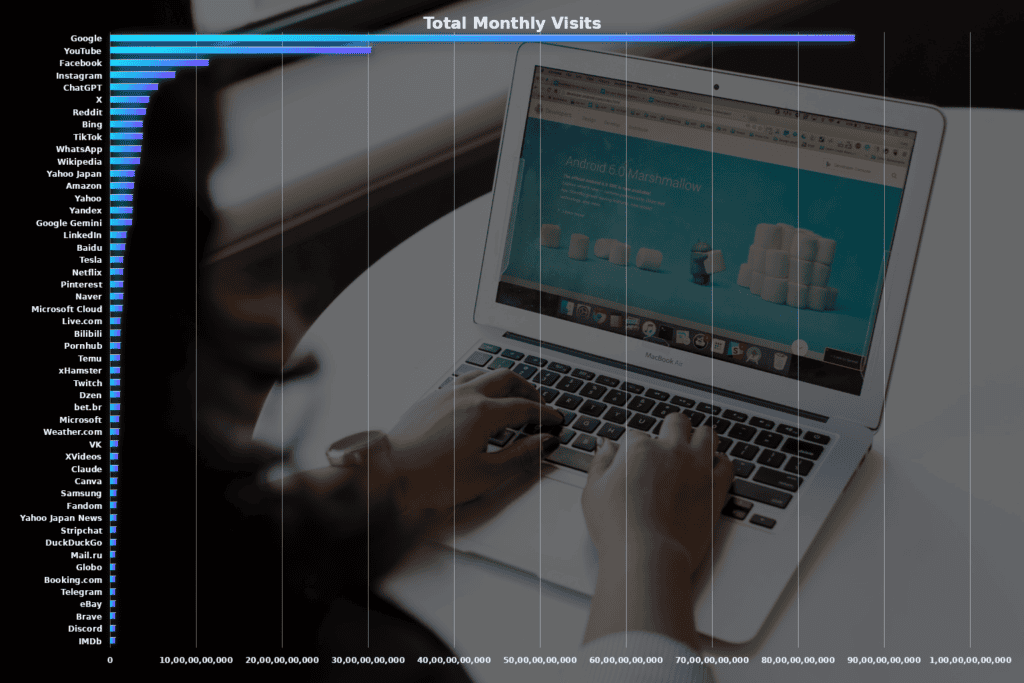
Google is in a Different traffic universe.
Google stands at the top with about 86.6 billion visits in August 2026. YouTube comes next with 30.4 billion. Facebook has 11.5 billion Instagram reaches about 7.6 billion and ChatGPT gets roughly 5.6 billion.
The difference between first and second place is huge. Google received 2.85 times as many monthly visits as YouTube. It got 7.5 times as many as Facebook.
Google alone made up around 40% of all the monthly visits from the top 50 websites in the dataset for August 2026.
That means Google isn’t another top website. It’s like digital infrastructure. People don’t go to Google because they want to stay on Google. They go because they want to find something or reach somewhere else.
Search is one of the internet’s gateways and that gateways gather traffic.
| Rank | Website | Total Monthly Visits |
|---|---|---|
| 1 | 86,590,000,000 | |
| 2 | YouTube | 30,400,000,000 |
| 3 | 11,500,000,000 | |
| 4 | 7,600,000,000 | |
| 5 | ChatGPT | 5,600,000,000 |
| 6 | X | 4,600,000,000 |
| 7 | 4,200,000,000 | |
| 8 | Bing | 3,800,000,000 |
| 9 | TikTok | 3,800,000,000 |
| 10 | 3,700,000,000 | |
| 11 | Wikipedia | 3,500,000,000 |
| 12 | Yahoo Japan | 2,900,000,000 |
| 13 | Amazon | 2,800,000,000 |
| 14 | Yahoo | 2,700,000,000 |
| 15 | Yandex | 2,700,000,000 |
| 16 | Google Gemini | 2,600,000,000 |
| 17 | 2,000,000,000 | |
| 18 | Baidu | 1,800,000,000 |
| 19 | Tesla | 1,600,000,000 |
| 20 | Netflix | 1,600,000,000 |
| 21 | 1,600,000,000 | |
| 22 | Naver | 1,600,000,000 |
| 23 | Microsoft Cloud | 1,500,000,000 |
| 24 | Live.com | 1,300,000,000 |
| 25 | Bilibili | 1,300,000,000 |
| 26 | Pornhub | 1,300,000,000 |
| 27 | Temu | 1,200,000,000 |
| 28 | xHamster | 1,200,000,000 |
| 29 | Twitch | 1,200,000,000 |
| 30 | Dzen | 1,200,000,000 |
| 31 | bet.br | 1,200,000,000 |
| 32 | Microsoft | 1,100,000,000 |
| 33 | Weather.com | 1,100,000,000 |
| 34 | VK | 1,000,000,000 |
| 35 | XVideos | 956,400,000 |
| 36 | Claude | 950,200,000 |
| 37 | Canva | 863,700,000 |
| 38 | Samsung | 816,900,000 |
| 39 | Fandom | 814,600,000 |
| 40 | Yahoo Japan News | 793,900,000 |
| 41 | Stripchat | 743,600,000 |
| 42 | DuckDuckGo | 699,100,000 |
| 43 | Mail.ru | 697,500,000 |
| 44 | Globo | 694,600,000 |
| 45 | Booking.com | 693,900,000 |
| 46 | Telegram | 674,300,000 |
| 47 | eBay | 670,000,000 |
| 48 | Brave | 666,300,000 |
| 49 | Discord | 665,600,000 |
| 50 | IMDb | 664,300,000 |
The Top of the Web Is Extremely Concentrated
When you group the leading websites together the concentration becomes even clearer.
The Top five—Google, YouTube, Facebook, Instagram and ChatGPT—account for about 65.9% of the monthly visits among the top 50. The top 10 make up around 75.3%.
That means the other 40 websites combined represent, less than a quarter of the total traffic in this top-50 group.
The internet is vast. Its traffic is not.
A small number of platforms have become the backbone through which global digital activity passes. This concentration also explains why tiny changes at big websites can mean massive shifts in visit numbers.
For a site, a 5% increase might be worth noting. For a site, with 30 billion monthly visits, 5% increase equals 1.5 billion additional visits. This Scale changes everything.
The Important New Story: AI Has Entered the Top Tier
Perhaps the most important change in the 2025–2026 website rankings is not another social network. It is Artificial intelligence.
ChatGPT is fifth worldwide with about 5.6 billion monthly visits in August 2026. Googles Gemini has about 2.6 billion visits ranking sixteenth. Claude has about 950 million visits, ranking thirty-fifth.
Combined those three AI platforms alone represent more than 9.1 billion monthly web visits.
Their growth rates tell an even more interesting story.
Similarweb’s August data shows Gemini grew about 148% from year while Claude grew more than 560%. ChatGPT by contrast fell about 2.9% from year.
These figures should not be interpreted as a leaderboard of AI usage.
The platforms have starting points, product strategies, user bases and traffic patterns. A 560% increase from a small base is mathematically very different from 20% growth at several billion visits.
Still the direction is unmistakable: AI websites have moved from being destinations to major components of the global web.
The internets old question was: “Where can I find this?” Now many ask: “Can something answer this for me?” This is a change in how people use the web.
Search Is Still King—. Search Is Becoming More Complicated
The top 50 also show that traditional search engines stay important. Google leads. Bing is eighth with 3.8 billion visits. Yahoo Japan, Yahoo, Yandex, Baidu, Naver, DuckDuckGo and Brave also appear in the ranking.
This reminds us that the global internet is not one market. Search habits differ by place, language, tech ecosystem and local history.
A search engine that is highly visible in one country may be nearly invisible, in another.
The result is a web where a few companies run huge international platforms while local services keep strong domestic or language audiences. The ranking shows geography even though it is not a list.
Regional Internet Power Is Visible Between the Lines
When we look closely at the top 50, We see the internet starts to split into regional ecosystems.
Yahoo Japan remains one of the world’s largest domains. Yandex remains significant. Baidu and Naver occupy positions. Bilibili and Dzen appear in the 30. VK enters the 50. Globo represents a Brazilian-language digital ecosystem. Mail.ru remains substantial.
These are not simply smaller versions of American platforms. Many have developed within different media, language and consumer environments. That matters because the internet is often described as if everyone uses the same platforms but people does not.
The web is global in infrastructure but frequently regional in behaviour.
E-Commerce Is Important— It Does Not Dominate the Top
Amazon is the highest‑ranked conventional marketplace in the August 2026 top 50 with around 2.8 billion monthly visits. Temu follows at about 1.2 billion while Booking.com and eBay also make the list.
The interesting feature is not that shopping websites are absent.
It is that shopping websites are significantly smaller than search, social media and video giants.
Amazons 2.8 billion monthly visits may sound enormous— They are—but they represent only a fraction of Googles traffic.
This tells us something about the internet economy.
People may buy products rarely compared with how often they search, communicate, watch or scroll.
The web is therefore not simply a shopping mall. Internet is an attention machine.
Commerce is one of the activities that happens inside Internet.
Streaming Is More Fragmented Than You Might Expect
Netflix reaches 1.6 billion monthly web visits placing Netflix nineteenth in the August 2026 Similarweb ranking.
That position requires some context. Website visits are not the same as hours watched.
A streaming service can have viewing activity inside apps and connected‑TV environments without generating equivalent website traffic. That is why web rankings should not be mistaken for rankings of entertainment consumption.
So the presence of Netflix among the worlds 20 largest web domains shows how strongly subscription entertainment has become embedded in internet behaviour.
YouTube remains the outlier because YouTube combines video consumption with a massive, web‑search‑like discovery system.
The Big Pattern
The Internet Is Built Around Habit
The striking pattern in the top 50 is not the dominance of any particular company.
It is the dominance of repeated habits.
- Google answers questions.
- YouTube supplies video.
- Facebook and Instagram provide feeds.
- ChatGPT provides answers and assistance.
- X and Reddit provide conversation.
- TikTok supplies discovery.
- WhatsApp provides communication.
- Amazon provides commerce.
- Wikipedia supplies reference information.
- Netflix supplies entertainment.
These are not isolated websites competing for visitors. They are embedded into routines.
That is why the biggest platforms are so difficult to displace.
The strongest digital businesses are not necessarily the ones people visit because they have consciously decided to “use a website.” They are the places people instinctively open whenever a familiar need appears.
The Ranking Also Shows How Powerful Platforms Become Ecosystems
Another pattern is ownership concentration.
- Google appears through major properties, including Google Search, YouTube and Gemini.
- Microsoft appears through Bing, Microsoft, Live.com and cloud.microsoft.
- Meta controls Facebook and Instagram.
The result is that a ranking of 50 websites can exaggerate the diversity of the internet. Fifty domains do not necessarily mean fifty digital powers.
Several of the important destinations belong to the same corporate ecosystems.
This matters because platform power is better understood by looking at families of services, not individual domains.
A company can operate search, video, advertising, cloud infrastructure, AI and productivity services simultaneously.
The domain ranking sees websites. The underlying digital economy sees ecosystems.
Some of the Interesting Websites Are Not the Biggest
The lower half of the top 50 contains some fascinating signals.
- Canva records 864 million visits.
- DuckDuckGo records around 699 million.
- Brave reaches 666 million.
- Discord records 666 million.
- IMDb receives 664 million.
- GitHub records 649 million.
None comes close to Google. Each represents a very different internet behavior.
- Canva represents creation.
- DuckDuckGo and Brave represent alternative approaches to search and browsing.
- Discord represents community communication.
- IMDb represents information, around entertainment.
- GitHub represents software development and open-source collaboration.
The internets long tail is therefore not merely populated by versions of the giants. It contains digital institutions that perform very specific functions.
One of the Biggest Traffic Changes Is Invisible
Website rankings have a built-in blind spot: apps.
Someone can spend hours watching TikTok, messaging on WhatsApp browsing Instagram or watching YouTube without generating the pattern of website visits that a desktop or mobile browser user would.
Similarweb explicitly states that its website ranking does not include mobile-app traffic.
That means the top 50 should never be interpreted as “the 50 apps and websites humans use most.” It is a ranking of web domains.
This distinction is becoming increasingly important as the internet moves away from the browser tab and into apps, operating systems, smart televisions, voice interfaces and AI assistants.
The traditional website is still enormously important. It is no longer the whole internet.
Conclusion: The Internet Is Smaller Than It Looks
The modern web feels infinite.
It contains websites for every conceivable interest, language, profession, hobby and obsession.
Yet the traffic tells a story.
In the August 2026, Similarweb snapshot the top 50 websites generated 214.9 billion monthly visits with Google alone accounting for approximately 86.6 billion. The top 10 captured three-quarters of the traffic represented in the top-50 group.
That concentration is the defining feature of the web. Beneath it lies a more interesting story.
- Video remains enormous.
- Social platforms continue to shape behaviour.
- Regional internet ecosystems remain powerful.
- Online commerce has become routine.
- Specialized communities such as Reddit, Discord and GitHub demonstrate the persistence of niche spaces.
- Artificial intelligence is rapidly becoming a new destination for human attention rather than merely another technology operating behind the scenes.
The biggest change may therefore not be which website occupies a rank next month. It may be the changing definition of what a website’s supposed to do.
- Search engines once helped us find information.
- Social networks helped us find people.
- Streaming platforms helped us find entertainment.
- Marketplaces helped us find products.
- AI assistants increasingly try to help us find—or generate—the answer itself.
The internet is still made of billions of websites.
Increasingly people experience that enormous world through a surprisingly small number of digital gateways. Those gateways are where the real battle, for global attention is taking place.
Subscribe to our $1 newsletter to get new Data and Maps from around the world on various different topics every month. Click here now to join.
Sources
- Similarwebs Top 100 Visited Websites in the World. August 2026 offers the most recent full monthly global website-traffic data. In this dataset Google recorded 86.59 billion visits while YouTube had around 30.4 billion.
- Similarweb’s ranking is based on monthly visits counting both desktop and mobile web traffic. It does not include traffic that happens within mobile apps.
- Kepios/DataReportals 2025 Global Overview uses Similarweb data from June to August 2025 to provide a check for 2025 trends. According to this data Google had an average of 83.3 billion visits YouTube had 29.9 billion Facebook had 11.9 billion Instagram had 6.55 billion and ChatGPT had 5.65 billion.
- Cloudflare Radar offers a view of global internet activity. It uses. Anonymized traffic data from Cloudflare’s 1.1.1.1 DNS resolver to validate the overall picture.
Methodology
The index is defined as the 50 websites searched or visited globally from 2025 to 2026. It is treated as a website-traffic ranking with total monthly web visits, as the main measurement.