
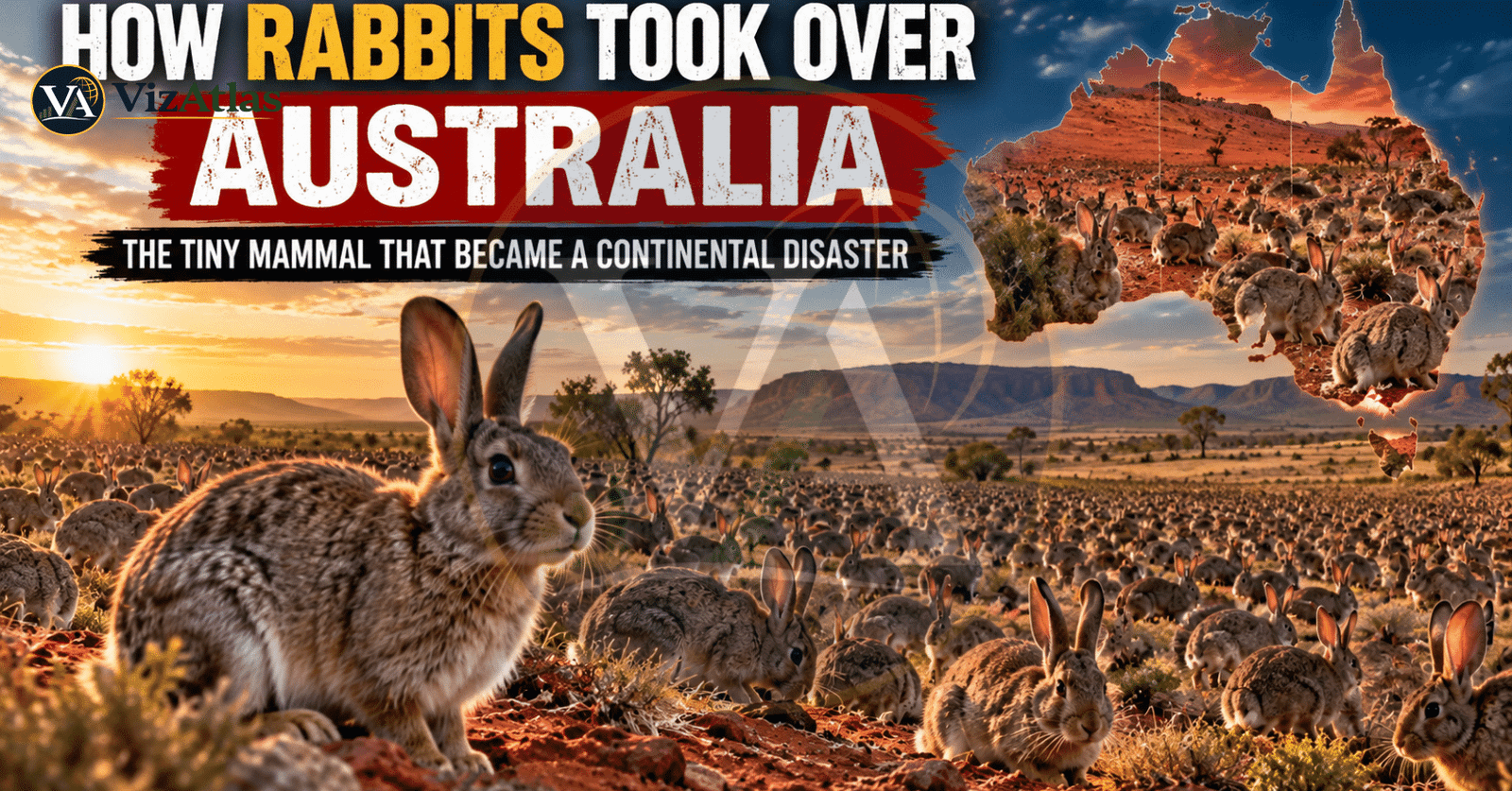
How Rabbits Took Over Australia: The Rabbit Plague That Became a National Disaster
The rabbit is one of the least intimidating animals. Small, soft and usually connected with gardens, farms and children’s books. You’d find it hard to imagine the rabbit as a big problem for the environment across an entire continent. In Australia, rabbits became one of the most harmful animals that the country has ever dealt with.
It began in the 1800s, when people from Europe brought rabbits to the land. Even though the animals had been there before in numbers, including with the First Fleet in 1788 they didn’t cause any major issues. It was in 1859, when an English-born farmer named Thomas Austin brought rabbits to his property at Barwon Park, near Geelong in Victoria.
What happened next was amazing.
The rabbits grew in large number spread across areas and fought with other animals and livestock for food. They ate plants took over farmland and pastures and made the soil worse and the native plants disappear.
Years later, Australians were fighting a pest that seemed impossible to stop.
Big fences were built rabbits, they were caught, their homes were destroyed and eventually they used special methods to control them. The arrival of the virus and the rabbit hemorrhagic disease virus (RHDV) killed many rabbits but the rabbit problem was not gone yet.
What the Australian rabbit invasion showed was not a story about an animal that multiplied quickly but also a lesson, about what can happen when a species is placed in a place where the environment has not developed along the same lines.

Where Did Australia’s Rabbits Come From?
The rabbits that defeated Australia weren’t Australian animals.
The organism involved is the European rabbit, Oryctolagus cuniculus. This species comes from parts of the Iberian Peninsula and the southern region of France.
Why were rabbits brought to Australia? European settlers introduced them for food, fur and skins. They also wanted them for hunting and sport.
The first rabbits arrived with the First Fleet in 1788. These early rabbits didn’t cause the massive rabbit infestation that would happen later. Research shows large number of rabbits had been brought to Australia many times before 1859.
The turning point happened in Victoria.
Thomas Austin’s rabbits
Thomas Austin was a British immigrant and a pastoralist. In Britain, rabbit hunting was a pastime. He wanted rabbits on his land so he could hunt them.
In 1859, rabbits were shipped from England to Australia. There are records of 24 rabbits arriving. The National Museum of Australia says 13 wild rabbits were released at Barwon Park on Christmas Day in 1859.
It seemed simple create a group that could be hunted. But the result was anything but simple.
Within a small time, huge numbers of rabbits were being killed across the estate. The population grew way beyond what the initial release suggested.
What started as an experiment, accidentally began one of the most surprising mammal invasions in history.
How Did Rabbits Spread Across Australia So Quickly?
Reproduction is unlikely to explain the rabbit invasion.
Factors that helped rabbit spread and rabbit population growth are aided by Australian Environment.
Rabbits breed fast but the real advantage is the rabbit ability to breed fast, adaptable behaviour, presence of vegetation, burrows and enormous size of Australia.
A rabbit does not require an environment to live in. Rabbit is adaptable, feeding on any types of plant material and settling in open country, in farmland and woodland and even on coastal and inland areas of Australia.
A powerful reproductive system
Rabbits can have babies quickly if there is plenty of food and good conditions.
Rabbits are capable of breeding in any times of the year when conditions are right and rabbit numbers can quickly bounce back following droughts, disease outbreaks and control programs.
This creates a cycle:
More rabbits → More breeding → More young rabbits → Bigger population → More food eaten → Higher environmental pressure.
But Reproduction was just the beginning.
Warrens gave rabbit protection
Rabbits dig underground warrens.
Rabbit burrows offer protection against predation, bad weather and any control measures. Rabbit population can thus persist, when the above ground environment is unsuitable.
Rabbit burrows became problems, for the farmers and governments. Rabbits killed above ground, did not always mean that the underground population was killed as well.
Australia was vast.
After rabbit arrived, they had plenty of land for themselves.
The invasion moved through farms and wild lands, slowly covering large parts of southern Australia. Within 70 years, rabbit spread quickly across about 70% of Australia, which was the fastest mammal pest invasion ever says CSIRO.
That is why rabbit invasion was so strange in Australia. It was not a local pest issue anymore. It turned into a huge continental problem now.
The Rabbit Population Explodes
Australian settlers were surprised by how the rabbit invasion spread.
Rabbits kept moving from Victoria into regions heading west and north.
The rabbit reached the Murray River and entered the borders of New South Wales by 1880. Later the rabbits crossed into Queensland and by the 1890s they had reached Western Australia.
The scale of the rabbit expansion was astonishing.
“Will the rabbit invasion never end?”
Australians can not take any comfort from the fact that the spread of rabbits through Britain took two centuries whereas the introduced Australian population somehow managed to colonise enormous areas in just a few decades.
By the century rabbits were no longer a target for Australians who hunted them for sport. They were everywhere.
Farmers began to see their pastures lose cover, Grasses and leaves on trees and shrubs stopped growing easily. Native animals and farm livestock fought with rabbits for food and shelter. The rabbit had now become an ecological force.
Why Were Rabbits So Destructive?
The biggest error is thinking that rabbits caused the damage just because there were so many of them.
Actually the real effect came from what the rabbits ate and what happened after that.
Animals like rabbits that eat certain plants prefer the best and nutritious parts of the plants and go for new growth. Even if there aren’t rabbits, they can stop native plants from growing back. Fewer than two rabbits per hectare could be enough to stop some native plants from growing, according to CSIRO.
This causes a problem over time.
Picture a forest with trees. The Old trees stay alive. Rabbits eat the young seedlings. Over time the old trees dies and aren’t replaced. So the area might look okay for years before the real damage shows up.
Rabbits and farm animals
Rabbits also fought for food with farms.
Sheep and cattle ate grass and other plants. Rabbits also needed the grass and plants to live. The competition got worse during tough times like Drought or poor rainfall. So there might not be plants for the farm and wild animals.
Soil Erosion
Plants keep the soil safe. If grasses and young plants are gone, the wind and water can take the soil away.
Rabbits digging in the ground also messes up the soil. Old records show that areas got worse as rabbit numbers went up.
This started a chain of effects:
Rabbits eat vegetation → vegetation fails to regenerate → soil becomes exposed → erosion increases → habitat quality declines.
So the harm went way beyond just the plants that rabbits ate.
Australia’s Native Wildlife Also Paid the Price
Australian animals were already very different from those in other continents. Most of them had developed very differently than the ones in Europe.
Rabbits created a lot of competition for food and shelter.
Native animals might have lost their homes because of rabbits or rabbits might have been eating the plants that native animals needed. The plants were affected, which had effects on the food chain.
A another major problem was changes in the predator groups in Australia.
European settlements changed the predator groups in parts of Australia. Dingoes and local predators, like quolls were removed from much of the country while foreign predators like foxes and cats stayed in numbers. Studies from those times show that this affected the environment during the rabbit invasion.
This is important because new animals are never alone. Rabbits were one part of the bigger environmental changes caused by the arrival of European people.
Australia Declares War on the Rabbit
Australians soon started trying everything they could think of. They trapped rabbits. They shot rabbits. They poisoned rabbits. They destroyed rabbit warrens. They offered bounties.
Then out of nowhere one of the most extraordinary replies: rabbit-proof fences.
The idea was simple. If we can not stop growth of Rabbit biologically, stop rabbit physically.
The leading authorities who are least experienced in trying to control insects have developed kilometres of rabbit-proof fencing to exclude rabbits from farm land. The most ambitious and well known of the many fences was built in Western Australia between 1901 and 1907. The fence was 3,256 kilometres in length from the northern to southern ends.
There was a fundamental problem though. Rabbits were already spreading. The sole purpose of a fence was to keep the pest on the other side. Rabbits had already managed to get over some fences in various locations.
Maintaining some fences was a challenge as Australia was so vast and had harsh weather. The fence was also a symbol of Australia’s battle, against an enemy that could burrow underneath, slip through the holes and appear on the other side.
The First Major Breakthrough: Myxomatosis
The country needed a solution that worked across the nation by the middle of the twentieth century.
Fences were not enough to cover every area. Shooting was not fast enough. Poisoning had limits. Then scientists looked for Biological control.
The biggest breakthrough was myxomatosis, a disease caused by a myxoma virus.
The myxoma virus was first studied as a way to control rabbits by scientists in the 1930s and 1940s. It was released into rabbit populations in Australia during the early 1950s. The results were very strong.
Once it was introduced, rabbit numbers in some places dropped by more than 90 percent. Before this, no biological weapon was able to be used on rabbit populations so that it would spread on its own without people having to touch each rabbit.
This was a change in how pests were controlled but It did not work forever.
Evolution Fights Back
The rabbit invasion produced an extraordinary showcase of evolution.
Yes as Myxomatosis spread, rabbit populations with good resistance had greater chances of surviving long enough to reproduce.
Meanwhile the virus itself changed. Myxomatosis’s initial dramatic effect lessened over time.
Led to an Evolutionary arms race:
Scientists introduce disease → susceptible rabbits die → resistant rabbits survive → resistant rabbits reproduce → virus and rabbit populations evolve.
Agriculture Victoria pointed out that the myxoma virus became less effective against rabbit populations as their genetic resistance increased.
The lesson was profound. Though even a successful biocontrol agent would never have been enough to eradicate rabbit populations.
The Second Biological Weapon: Rabbit Haemorrhagic Disease
Later Australia turned to another disease to control rabbits: Rabbit Haemorrhagic disease virus that people commonly call the rabbit calicivirus or RHDV.
RHDV led to a drop in rabbit numbers especially in the drier parts of the country. Over time, RHDV became a part of Australia’s long-term plan to control rabbit populations.
The rabbits adapted again. Resistance started to appear. New strains and variants of the virus kept emerging, making control more difficult.
This situation served as a wake-up call for Australia. It showed that managing a pest is much easier than eradicating a pest.
Rabbit populations can bounce back when disease pressure drops, when food becomes more available or when rabbit control programs are reduced.
Why Can’t Australia Simply Eradicate Rabbits?
This question could be the important one.
Australia has been fighting a war on rabbits for more than a century yet why has it not simply gotten rid of them?
The answer is the scale of the problem.
Australia is very large. That makes the problem bigger.
Rabbits are widespread across Australia.
Rabbits reproduce quickly.
Rabbits live underground.
Rabbits occupy both farm lands and natural areas.
Rabbits can bounce back after any control measures.
Controlling rabbits in times therefore needs an integrated approach, with many options, not just one simple solution.
These methods can include:
- destroying warrens
- poisoning
- fencing
- shooting
- habitat management
- biological control
- monitoring
- coordinated landscape‑scale management
The aim is usually to keep rabbit numbers very low so that ecosystems and farms can recover, instead of trying to remove every single rabbit. This is especially important because a few rabbits can stop many native plants from regrowing.
The Economic Cost of Australia’s Rabbit Problem
The invasion of the rabbits has never been an environmental matter. It has also been an economic one.
Rabbits are interfering with Livestock. There is competition between livestock and rabbits. Rabbits eat off the Agricultural land, they eat plants and they cause damage to the land. Rabbits cause problems with tree establishment as well.
Potential losses to agriculture and horticulture are estimated by CSIRO to amount to about A$239 million per year and it does not include environmental and social costs.
Another CSIRO reference calculates economic damage as A$200 million per year and this variation in figure illustrates clearly that the value depends on which costs are counted and how they are calculated.
What matters here is that the cost is not the value of crops eaten by rabbits. It accounts for the broader impacts of degraded land, lower agricultural yields and the cost of managing the animals.
Conclusion: From Hunting Game to Continental Disaster
Australia’s rabbit problem began with what seemed like an harmless idea—bringing European rabbits to the country for hunting.
Those rabbits found a place to thrive. They bred quickly, multiplied fast and spread across the land.
At Thomas Austin’s Barwon Park estate in 1859, they started from the Ballarat region. Soon covered huge parts of Australia. They fought with livestock for food, ate plants, ruined crops, made the soil erode faster and stopped many native species from recovering.
Australia decided it had to act. It launched one of the largest pest-control efforts in history.
They built thousands of kilometers of fences to keep them out. Rotten traps, destroying warrens and poisoning became routine—just as common as seeing a kangaroo hop. Then came the turning point: diseases arrived. First myxomatosis, then RHDV. These wiped out large colonies in a flash.
The rabbits survived. That might be the most important part.
Australia didn’t face an enemy that could be defeated once and forgotten. It faced a living growing population. A population that kept giving birth ,kept living, kept changing and kept taking back the land.
So the rabbit became more than an agricultural nuisance. It became a lesson—one about ecology, evolution and the big surprises that come from unintended actions.
One of the world’s most famous invasive-species disasters started because of a few rabbits released for sport. Even now more, than a hundred years later Australia still can’t beat the offspring of those original rabbits.
Subscribe to our $1 newsletter to get new Data and Maps from around the world on various different topics every month. Click here now to join.
Frequently Asked Questions
- When did they arrive in Australia?
There were a number of introductions of rabbits to Australia before the mass invasion in 1859, including with the First Fleet in 1788. The biggest mainland invasion was in 1859 when Thomas Austin released a group of rabbits at Barwon Park in Victoria.
- Why did rabbits spread quickly in Australia?
The way they reproduce quickly, their ability to live in different places, underground burrows and access to large areas for a suitable living space all helped the rabbits spread very fast. Those changes were affected by modifications to ecologies due to European settlement.
- What damage have rabbits done in Australia?
The damage caused by the Rabbit is estimated by CSIRO as costing Australian Agriculture and horticulture about A$239 million every year (not including environmental and social costs) in losses to crops and pastures competition with livestock and native animals, pastures and native plant regrowth and soil degradation.
- What was the rabbit-proof fence?
The rabbit-proof fence was a series of fences built to keep rabbits out of the pastoral areas of Australia. The famous western Australian rabbit-proof fence was built from 1901 to 1907 and was about 3,256 km long.
- Did myxomatosis eliminate Australias rabbits?
No. Myxomatosis killed off a large number of rabbits when it was first introduced but rabbit numbers were able to come back partly because both rabbits and the disease were able to change over time. Myxomatosis still plays a part in Australia’s history of rabbit control but will not be the final answer to rabbit infestations.
- Are rabbits still a problem in Australia today?
Yes. The European rabbit is still one of Australia’s invasive animals. It keeps causing problems, for agriculture and native plant and animal life and Australia still uses control methods to keep rabbit numbers low.