Top 50 Biggest Companies in the World by Market Cap 2025–2026: Global Ranking
The world of business is changing. Companies in the technology field, AI, semiconductor, banking, healthcare, energy and consumer sectors are all trying to get a bigger share of the world’s economy. Most Important in this competition are some of the biggest companies in the world by market cap now going up to some amazingly higher levels.
Apple, Nvidia, Microsoft, Alphabet and Amazon are becoming the big companies worth trillions of dollars. The old big companies – like Saudi Aramco, Walmart, KKR and LVMH – are still showing how strong traditional industries can be.
Artificial intelligence has had an impact on the global market. Demand for processors, semiconductor production, cloud computing and data centres has raised the worth of technology companies. At the same time, banks, chemical makers, energy firms and retail brands still hold a strong position in the global market.
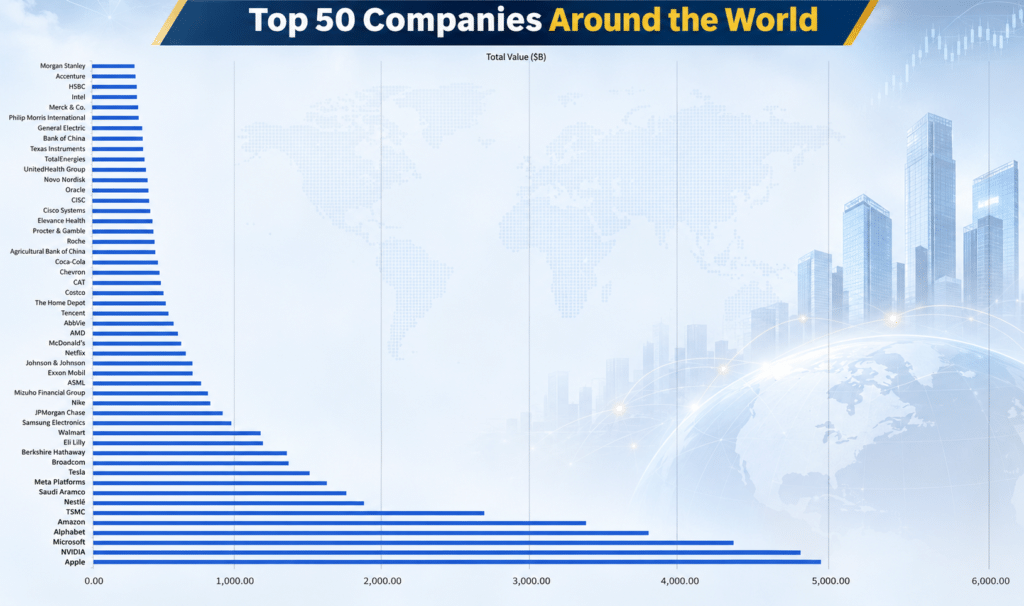
Our VizAtlas ranking examines fifty of the largest companies worldwide based on their 2025‑2026 market capitalisation. It lists each company’s country of domicile, market value and industry.
How Is Company Market Capitalisation Calculated?
Market capitalisation or market cap shows how much a company is worth in the stock market. It is calculated by taking the price of one share and multiplying it by the total number of shares that are out there.
For example: if a company has one billion shares and each share is priced at $100, then the market cap comes to $100 billion. This number helps investors understand the size of a company to others.
Market Capitalisation is one of the popular measurements used to compare the relative sizes of publicly traded companies. It allows investors to gauge how businesses are valued by the markets and can provide insight into the broader picture of a company’s standing in the world economy.
Market cap isn’t the same as company revenue, profit, asset value or the company’s cash balance. It is simply the investment community’s valuation of how much equity in the company’s worth at a given moment.
Let us look at how companies are grouped by market capitalisation:
- Mega-cap: Companies valued above $200 billion.
- Large-cap: Companies valued between $10 billion and $200 billion.
- Mid-cap: Companies valued between $2 billion and $10 billion.
- Small cap: Companies valued between $250 million and $2 billion.
- Micro-cap: Companies valued below $250 million.
The 50 giants of the business world comfortably sitting in the mega-cap zone and hence, companies have a big presence on the global financial landscape.
Subscribe to our $1 newsletter to get new Data and Maps from around the world on various different topics every month. Click here now to join.
Which Are the 50 Largest Companies in the World by Market Capitalisation?
| Rank | Company | Country of Registration | Total Value ($B) |
|---|---|---|---|
| 1 | Apple | United States | 4,975.00 |
| 2 | NVIDIA | United States | 4,506.00 |
| 3 | Microsoft | United States | 3,940.00 |
| 4 | Alphabet | United States | 3,490.00 |
| 5 | Amazon | United States | 2,803.00 |
| 6 | TSMC | Taiwan | 1,947.00 |
| 7 | SpaceX | United States | 1,823.00 |
| 8 | Saudi Aramco | Saudi Arabia | 1,681.00 |
| 9 | Meta Platforms | United States | 1,560.00 |
| 10 | Tesla | United States | 1,415.00 |
| 11 | Broadcom | United States | 1,401.00 |
| 12 | Berkshire Hathaway | United States | 1,222.00 |
| 13 | Eli Lilly | United States | 1,206.00 |
| 14 | Walmart | United States | 995.84 |
| 15 | Samsung Electronics | South Korea | 933.16 |
| 16 | JPMorgan Chase | United States | 888.27 |
| 17 | Visa | United States | 788.58 |
| 18 | Micron Technology | United States | 780.68 |
| 19 | AMD | United States | 736.46 |
| 20 | Exxon Mobil | United States | 676.62 |
| 21 | Johnson & Johnson | United States | 664.94 |
| 22 | SK Hynix | South Korea | 604.50 |
| 23 | Mastercard | United States | 568.61 |
| 24 | ASML | Netherlands | 549.12 |
| 25 | AbbVie | United States | 514.92 |
| 26 | Tencent | Cayman Islands | 484.71 |
| 27 | China Construction Bank | China | 475.79 |
| 28 | Costco | United States | 466.86 |
| 29 | CXMT | China | 424.26 |
| 30 | Chevron | United States | 414.85 |
| 31 | Coca-Cola | United States | 411.56 |
| 32 | Agricultural Bank of China | China | 387.48 |
| 33 | Roche | Switzerland | 386.60 |
| 34 | Palantir Technologies | United States | 386.43 |
| 35 | Procter & Gamble | United States | 383.36 |
| 36 | Cisco Systems | United States | 370.01 |
| 37 | ICBC | China | 362.50 |
| 38 | Oracle | United States | 361.96 |
| 39 | Merck & Co. | United States | 361.72 |
| 40 | UnitedHealth Group | United States | 353.16 |
| 41 | Home Depot | United States | 342.67 |
| 42 | Bank of America | United States | 341.00 |
| 43 | Bank of China | China | 337.91 |
| 44 | General Electric | United States | 335.38 |
| 45 | Philip Morris International | United States | 308.41 |
| 46 | Novartis | Switzerland | 306.99 |
| 47 | Intel | United States | 299.12 |
| 48 | HSBC | United Kingdom | 297.66 |
| 49 | AstraZeneca | United Kingdom | 289.13 |
| 50 | Morgan Stanley | United States | 283.59 |
Which Country Has the Most Companies in the Top 50?
The geographic distribution of wealth is perhaps the most interesting part of this ranking.
America has the most companies featured on the list with 37 companies.
This ranking is supported by leadership in technology, large and sophisticated financial markets, consumer brand strength, pharmaceutical innovation and a huge domestic economy.
Next on the list are four companies from China reflecting China’s presence in banking, technology and chip manufacturing.
Other countries in the rankings are:
- South Korea: Samsung Electronics and SK Hynix.
- Switzerland: Roche and Novartis.
- United Kingdom: HSBC and Astra Zeneca.
- Taiwan: TSMC.
- Netherlands: ASML.
- Saudi Arabia: Saudi Aramco.
This illustration shows that the world’s largest companies are mainly clustered in a major economic centres.
It also shows that the value of Corporate market is not shared equally among countries. The United States still stands out in markets. Asian nations play a important role in making semiconductors and in the banking and technology supply chains.
Which Industries Dominate the World’s Biggest Companies?
Stripping away the company focus of this list, we take a look at the different industries that make up the global economy.
Technology and semiconductors: Technology is a strong sector. Apple, NVIDIA, Microsoft, Alphabet, Amazon, TSMC, Broadcom, Samsung, Micron and AMD show how important infrastructure, high-performance chips and AI are.
Banking and financial services: The financial services industry is still remain a essential part of the world economy. JPMorgan Chase, Berkshire Hathaway, Visa, Mastercard, China Construction Bank, ICBC and Bank of America are examples of the segment within the banking and financial services industry.
Healthcare and pharma: Eli Lilly, Johnson & Johnson, AbbVie, Roche, Merck and Novartis demonstrate the financial power in drug research, medical technology and healthcare.
Energy: Saudi Aramco, Exxon Mobil and Chevron show the lasting relevance of energy sources. The importance of oil and gas to the energy industry is clear from the strong market presence of Saudi Aramco, Exxon Mobil and Chevron.
Consumer goods and retail: The commercial power of consumer demand, retail distribution and familiar brands demonstrated by Amazon, Walmart, Costco, Coca-Cola, Procter & Gamble and Home Depot.
The main takeaway is that technology still seems to be at the heart of company valuations yet the broader economy remains powered by many other businesses.
Conclusion
Apple, NVIDIA and Microsoft hold the first three positions, with Apple in first place, NVIDIA in second place and Microsoft in third place. This confirms the strong financial presence of the IT sector. Alphabet, Amazon and TSMC also appear on the list completing the technology ranking.
Meanwhile Saudi Aramco, JPMorgan Chase, Berkshire Hathaway, Walmart and Eli Lilly demonstrate that energy, finance, retail and healthcare remain economic sectors.
Geographically, the United States is predominant in the ranking and China South Korea, Taiwan and certain European economies hold important places.
The important thing to keep in mind is that the world corporate rankings don’t stay the same. Changes in technology, shifts in consumer preferences, geopolitics and financial markets affect company valuation and can lead to changes in the rankings.
Today the firms at the top of the list may not be there tomorrow. However their huge market capitalisations give a guide to the types of business that investors are betting on.
Subscribe to our $1 newsletter to get new Data and Maps from around the world on various different topics every month. Click here now to join.
Sources
- Statista – The 100 Largest Companies in the World by Market Value, November 2026: Statista Global Companies Ranking
- Investor.gov – Understanding Market Capitalisation: Investor.gov
- FinanceCharts – Biggest Companies in the World by Market Cap: FinanceCharts
- The Motley Fool – Largest Companies by Market Capitalisation, November 2026: The Motley Fool
- Visual Capitalist – The World’s 50 Most Valuable Companies in 2026: Visual Capitalist
Methodology
- Market capitalisation is the measurement used.
- Reference date: November 9, 2026.
- All values are expressed in USD billions.
- Companies are ranked in descending order of market capitalisation.
- Each company is counted only once.
- Country refers to legal incorporation, not headquarters.
- Subsidiaries are not separately counted when the parent company is already represented, unless independently listed as a separate company.