
Countries With the Most AI Startups in 2026: Global Rankings
AI has moved from being a type of technology to becoming one of the biggest forces in the world economy. AI is now used in software, healthcare, finance, manufacturing, transportation, defense, education, agriculture, cyber security and every other area.
This growth is supported by a group of new companies. Tens of thousands of companies are creating AI models, AI-powered software, robotics systems, self-driving car technology and other things for people and businesses.
These companies are not spread out the same way everywhere.
Some countries have well-established AI groups that are supported by lots of investment money, good schools, smart workers, tech companies and large local markets. Other countries have very focused areas of AI work.
List of countries by number of AI companies that got funding as of 2026 according to the 2026 Stanford AI Index (Quid), The US is first with 8,909 new AI companies that got funding between 2013 and 2025, followed by China (1,766) and UK (1,057) The numbers show how many new AI companies got funding from 2013 to 2025. They do not show all AI companies that are active in each country.
This difference is important. There is not one list that includes all AI startups.. The definition of what counts as an AI company changes depending on the database you look at. The ranking in the data that comes with this is based on the method and data from the Stanford AI Index.
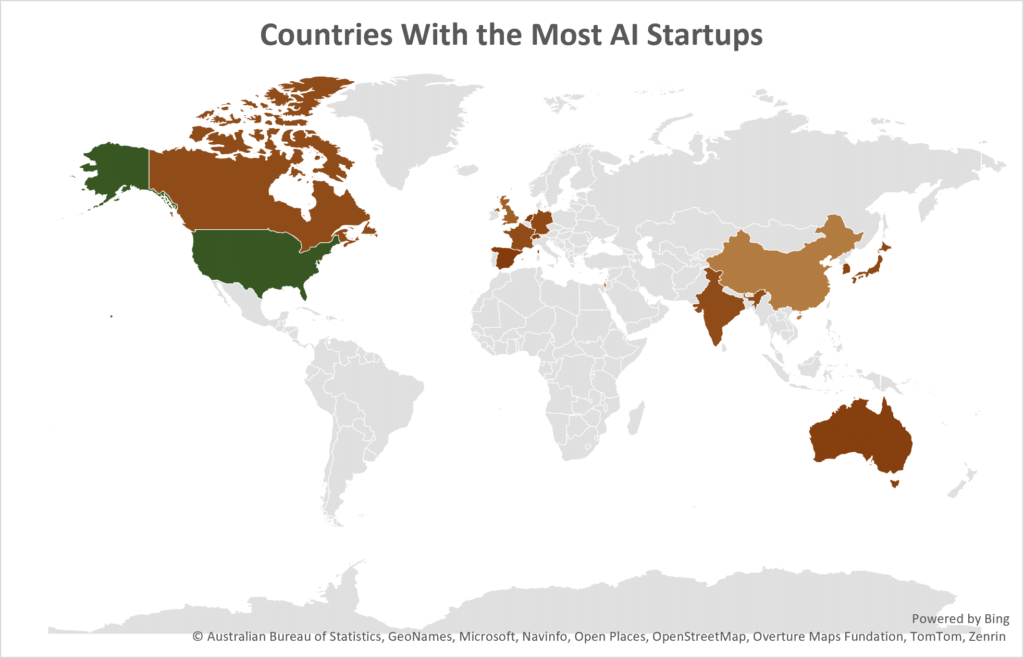
Which Countries Have the Most AI Startups in 2026?
| Rank | Country | AI Startups |
|---|---|---|
| 1 | United States | 8,909 |
| 2 | China | 1,766 |
| 3 | United Kingdom | 1,057 |
| 4 | Canada | 560 |
| 5 | Israel | 556 |
| 6 | France | 552 |
| 7 | India | 542 |
| 8 | Germany | 486 |
| 9 | Japan | 444 |
| 10 | South Korea | 329 |
| 11 | Singapore | 288 |
| 12 | Australia | 216 |
| 13 | Switzerland | 188 |
| 14 | Spain | 150 |
| 15 | Netherlands | 141 |
Why Are AI Startups Concentrated in a Few Countries?
It is clear from the map of AI startups: money, talent, research and markets all gather in the same places.
A new company working on AI might need access to computing equipment, experts, scientists and a lot of money. Countries that have all of these resources are more likely to have AI companies being created.
Venture capital plays an important role.
The OECD reported that 61% of all global venture capital investment went to AI companies in 2025. That amount was around $258.7 billion. US-based companies got 75% of the total value of AI-related venture capital deals, followed by the EU27, China and the UK.
This helps explain why AI startups tend to gather around single area.
When investors, researchers and startup founders are all in one place, new companies can come together faster. Successful founders start companies. People who have experience in AI, start their businesses. Universities create workers. Investors put their money into those group of startups.
This leads to a cycle that keeps growing.
Subscribe to our $1 newsletter to get new Data and Maps from around the world on various different topics every month. Click here now to join.
AI Startups Are Not the Same as All AI Companies
The important thing to remember about this ranking is “What is an AI startup?“
There is no Global Standard rule that clearly defines an AI startup.
Some Databases include companies that are described as “AI companies” by themselves. Others include companies that have been funded by VCs. Some Databases include all companies that make AI products whereas some include startups.
The Stanford AI Index ranking here measures AI funding companies. The cumulative country table in the 2026 report covers the period 2013 – 2025 and is based on Quid data.
It should therefore be read as “The total number of existing AI companies in the country”.
For instance a nation could have AI companies that have been bootstrapped but are not present in a funding dataset. A company can also shut down merge, sold or pivot their business. That is the reason, a few rankings might have different numbers.
The United States Dominates Both Startup Formation and Funding
The startup ranking gets more interesting when you look at it next to the investment numbers.
For example in 2025, the US put $285.9 billion into private AI companies. China was second with $12.4 billion. The UK came in third with $5.9 billion in investments.
The US also recorded 1,953 AI companies that got funding in 2025.
That means America’s lead isn’t from old companies that grew over time. It’s also because new AI startups are still coming in fast.
Generative AI has made this trend even stronger. Stanford says than half of all private AI investment in the US in 2025 went to generative AI. That’s about $163.6 billion.
The result is that an AI industry where startups, investors and big tech companies are all moving faster and doing better than before.
What the Ranking Says About the Future of AI
The count of AI startups around the world will not decide the result of the AI startup race.
The next phase of the AI startup race will be shaped by factors like computing power, AI research, semiconductor supply chains, access to skilled workers, venture capital, government policy and the skill to turn research into products.
The United States is ahead in private investment and the creation of AI startups. China is a major competitor because it supports AI startups, provides government backing, has strong research and owns a huge tech market.
Europe has strong individual AI startup ecosystems but no single country dominates. The United Kingdom is the leading while France, Germany, Switzerland, Spain and the Netherlands are all well established.
India is very interesting because even though its AI startup ecosystem is still small, its mix of talent, digital infrastructure and large market could allow India to grow into a hub for AI startups.
Smaller nations such as Israel and Singapore show a possibility that a country with a relatively small population can still become a world leader in AI.
Conclusion
The world market for AI startups is too concentrated.
As the table shows the US is far ahead in the lead with a total of 8,909 AI companies funded by 2025. There are 1,766 startups in China and the UK is in third place with 1,057 startups. The next four include Canada, Israel and France while India and Germany are behind.
The rank doesn’t describe everything.
The number of startups is a reflection of activity not the overall size of an AI ecosystem. Investment, research, talent, computing power, patents, large models and successful companies also count.
Where the data is unequivocal is in demonstrating that AI development continues to be concentrated in a few countries. Capital and people continue to gravitate toward the existing centres of technology and new ecosystems are narrowing the distance.
Those who can connect talent, capital, research and the real-world adoption of AI technologies will be well-placed to lead the next phase of the AI revolution as AI becomes further embedded into the global economy.
Subscribe to our $1 newsletter to get new Data and Maps from around the world on various different topics every month. Click here now to join.
Sources & Methodology
- Source: Stanford Institute for Human-Centered Artificial Intelligence (Stanford HAI) 2026 AI Index Report, Chapter 4: Economy, Figure 4.2.13 the numbers below are from Quid.
- Type: New venture funding as a percentage of all ventures metric (2013–2025).
- What we are counting: The series uses the Stanford/Quid count of AI companies with than US$1.5 million in private funding. While this allows comparisons across countries it would not include all AI startups.
- Ranking: Countries are ranked from the highest, to the number of qualifying newly funded AI companies.