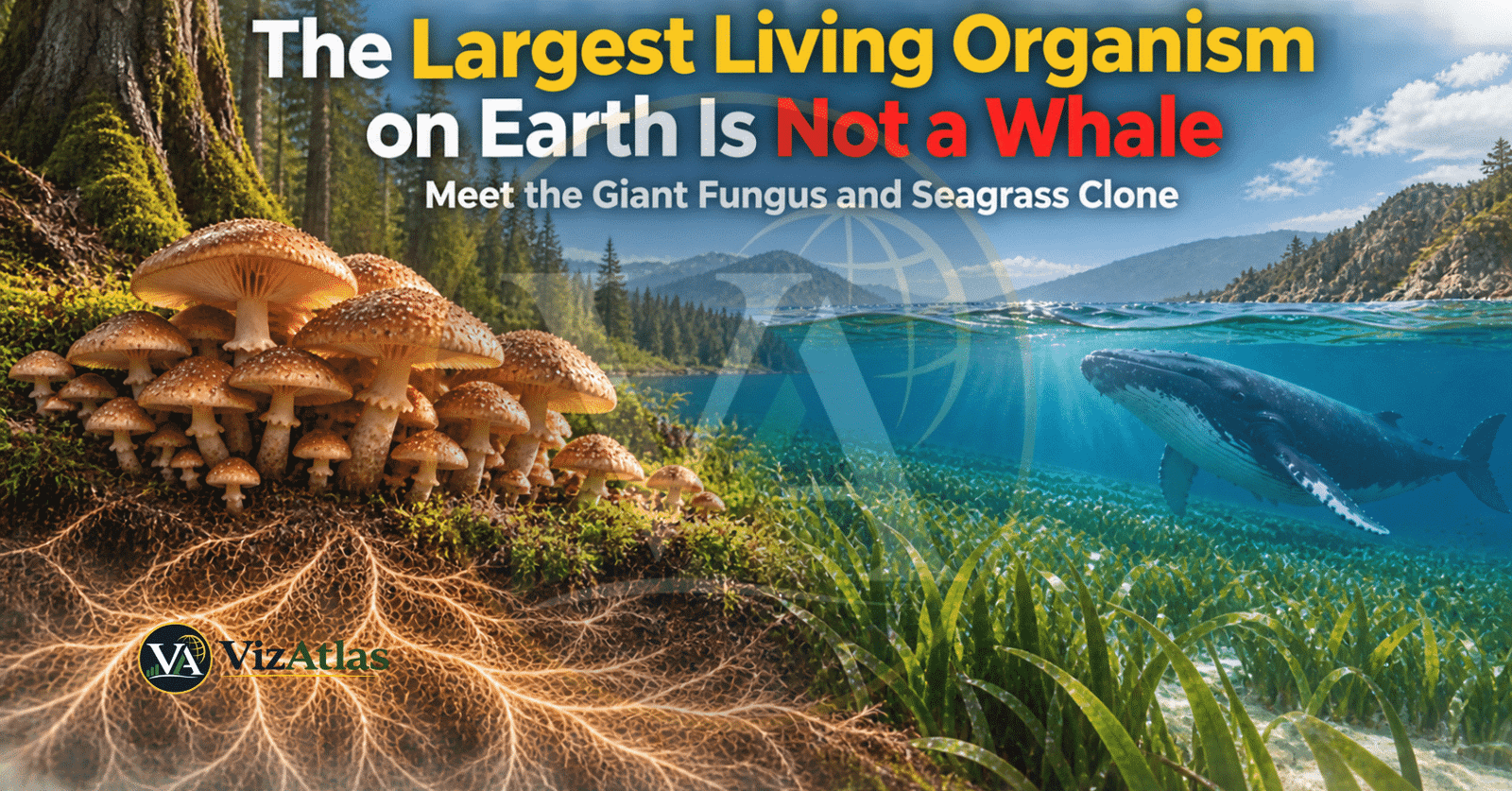
The Largest Living Organism on Earth Is Not a Whale: Meet the Giant Fungus and Seagrass Clone
The first thing that probably comes to mind when you think about the largest living creature today is a blue whale.
That makes sense.
The blue whale is the largest animal ever known to exist. It can grow up to 30 metres in length. Weigh more than 100 tonnes. But here’s something important to consider. There’s a difference between the largest animal and the largest living organism.
When we start looking beyond animals, things get more surprising.
Down in the forests of Oregon, there’s one fungus that spreads across thousands of trees. It connects them all growing underground like a network.
Not far from there in the waters off the coast of Western Australia, a single seagrass clone stretches over 180 kilometers. That’s more than city- to-city distances.
So what actually counts as the world’s living organism?
It depends on how we define “largest.” Are we talking about weight, Length or Just how much space it covers. The answer changes depending on the measure.
The Humongous Fungus of Oregon
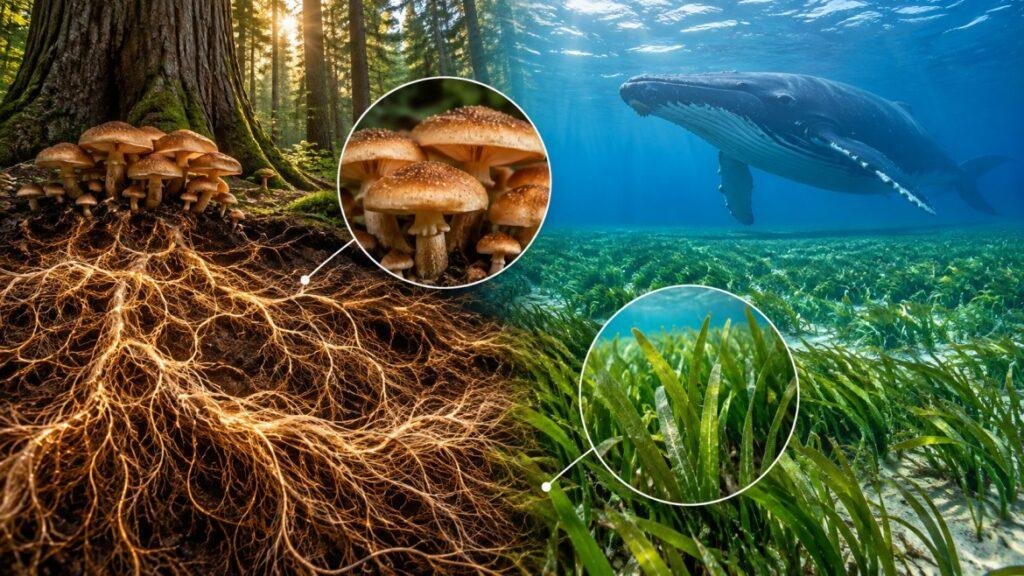
This is a Giant individual fungus “Armillaria ostoyae” in the Malheur National Forest in eastern Oregon. It is often called the “Humongous Fungus.”
Unlike the mushrooms we are used to seeing popping up from the ground, most of this organism stays underground.
What we see above ground is the tip of the iceberg. The visible mushroom is the reproductive part. The real body of the fungus lives beneath the soil. It consists of mycelium and rhizomorphs which’re root-like structures that spread through the earth.
The fungus moves through the soil. Connects with the roots of trees. These roots are all linked together, forming a network across a huge area.
According to the USDA Forest Service, Armillaria ostoyae is one of the largest known organisms on Earth. The biggest known genet of Armillaria ostoyae in the Malheur National Forest covers 2,385 acres or roughly 9.65 square kilometers.
That’s about the size of thousand football fields—or soccer fields if you prefer. There’s more. Its size isn’t the remarkable thing. This fungus might be thousands of years old. Scientists think this single fungus genet could be anywhere between 1,900 and 8,650 years old. The exact age depends on how the fungus spreads through the forest.
In other words, Part of this fungus may have existed long before most human civilizations even began. It grows slowly. In the forest study areas its growth rate is estimated at around 0.7 to 3.3 feet, per year—about 20 to 100 centimeters.
It doesn’t need to rush. It just keeps growing quietly spreading through the soil, deeper and wider every year.
How Can a Fungus Become This Big?
The secret is the way fungi grow.
A mushroom might look like a living thing to us but the part we see—the cap and stem—is only the reproductive section of the fungus.
The real body is mostly hidden underground.
Take Armillaria for example. This fungus sends threads deep into the soil and up into the roots of trees. These threads form networks beneath the ground.
In Oregon, scientists found a type of Armillaria called A. Ostoyae that forms something called a genet. A genet is basically one living organism even though it’s made up of many parts. The genetic testing proves it’s all connected.
Researchers studying the Oregon area discovered five genetically distinct genets. One of them was massive—covering 965 hectares.
So this one organism can be enormous, without anyone realizing it. You might walk through a forest. Think you are seeing just trees and plants. Beneath your feet one single fungus could stretch for kilometers quietly spreading underground growing in silence unseen.
The Fungus Is Not Harmless
The Humongous Fungus isn’t just resting underneath the soil. Armillaria ostoyae is a plant pathogen. It gets into trees by using their roots and can lead to death of trees. The fungus will also survive on wood once the tree is dead.
This makes the fungus presence important in the forests and contributes to the overall health of forest ecosystems—but it also makes it a dangerous forest disease.
Actually the reason why researchers got involved in the area was actually thanks, to tree mortality. The fungus had been hiding in sight for years.
All of what appeared to be infections proved to be different segments of one super massive creature.
But Is the Fungus Really the Largest Organism on Earth?
So this is where the story gets fun. The Oregon Armillaria has been traditionally reported as the world’s largest living organism for many years.
The phrase “largest” needs a measurement. When it comes to Weight, the Oregon fungus blows away the competition from miles. The US Forest Service estimated the weight of the Oregon Armillaria to be between 7,567 and 35,000 tons. These numbers came from calculations based on studies of Armillaria fungi.
According to the Guinness World Records, the heaviest organism ever recorded is Armillaria ostoyae, with a mass estimated at 6,800, to 31,750 tonnes.
If we look at surface area instead. Another creature takes the lead. This one lives underwater.
Meet the Giant Seagrass of Shark Bay
Sea grass clone in Shark Bay, Western Australia. One of a clone of sea grass called Posidonia Australis was found.
Initially it looks like a field of seagrass. Genetic testing showed something more surprising. Almost the entire meadow is one clone.
“Scientists sampled the seagrass from a different locations across Shark Bay and discovered that the same genetic individual extended for a length of at least 180km” said Bond lead author of the study. “The clone persisted over an area of around 200 km2 until parts of it were lost or destroyed by different processes.”
Those two areas do seem quite a bit smaller than the Oregon fungus. The research was published in Proceedings of the Royal Society B in 2022. The researchers found that the clone was the biggest known in any environment on the planet.
One Plant, Thousands of Shoots
How can a single plant be expanded to cover acres?
The answer is growth.
Posidonia Australis plant does not have to make a new genetically unique plant each time plant grows. Instead, Posidonia Australis plant can grow shoots vegetatively through underground stems called rhizomes. New shoots emerge from this system.
After thousands of years new shoots can spread across the seafloor. This can result in what appears to be thousands or even millions of plants yet genetically, plant may be the same individual.
Scientists believe that the Shark Bay clone is least 4,500 years old. However all clone plants have a curse when it comes to determining plant age.
So Which One Is the Largest?
There is no simple answer. It depends on the measurement.
Armillaria Ostoyae in Oregon, USA covers 2,385 acres or 9.65 km². It is the largest by Weight. It has a vast underground fungal network.
Posidonia Australis in Shark Bay, Australia spans 200 km2 of meadow. The clone extends at least 180 km and it is the largest known clone by area.
Pando (Populus Tremuloides) in Utah, USA covers 106 acres or 43 ha. It has a clonal aspen grove with tens of thousands of stems.
Blue whale in oceans can reach up to about 30 m long. It is the largest known animal. The distinction is important. The blue whale is truly the largest animal known to exist. The Oregon Armillaria to be the largest organism by weight and the biggest fungus ever discovered. The Shark Bay Posidonia australis clone as the world’s largest clone by area and the biggest known organism, by area too.
And Then There Is Pando
Another common candidate among the contenders is Pando in Utah, USA.
Species: Quaking aspen, Pando.
From the surface it looks like a forest filled with trees. Underground they are all connected by one shared root system. Genetically, they are all the one single organism. The grove covers 106 acres and has about 47,000 stems.
DNA tests showed every stem belongs to the same genetic individual. This makes Pando one of the amazing clonal colonies on Earth.
It also shows, how tricky it can be to think of one ” organism” when it looks so complex. When you walk among the trunks you see thousands of trees. But If you look at the roots and the DNA it’s all one massive being.
How Scientists Know They Are One Organism
This is probably the interesting part.
You can’t just look at a forest and say it is one living organism. They need proof.
For example, In an clonal organism, the DNA sample can be taken from two different places. Cloning helps scientists find out if two samples with genes are from the same clone.
The genetic and cell analysis from the group in the Shark Bay study showed a big clone that covers more than 180 kilometers.
In the same way, In their genetic and compatibility study of Armillaria, the scientists were able to tell the difference, between different types and so they marked the huge area of the Oregon sample.
So these are not things that can be judged based on their appearances. Their beginnings have a biological and genetic reason.
Conclusion
The giant‑sized blue whale is not the biggest organism on Earth. The answer depends on what we choose to compare with.
The huge fungus Armillaria Ostoyae, located in Oregon is estimated to be 2,200 years old. It covers ten square kilometers and spreads underground to form a massive mass.
More extreme is the clone of Posidonia Australis found in Shark Bay. DNA tests show that this clone stretches least 180 kilometres making it the largest known clone by surface area in the world.
The Pando grove shows that what looks like a forest can in fact be one large organism.
Even though the largest living organisms on Earth can be invisible. Many of the planets giants hide underground, underwater, are networked and are almost invisible.
This may be the surprising fact about life on Earth: sometimes the entire world is one living organism.
Frequently Asked Questions
What is the largest living organism in the world?
Answer: If we measure by area, a giant clone of Posidonia australis in Shark Bay, Western Australia is known to be the largest organism on Earth at 180 kilometers long and nearly 200 square kilometers of seagrass meadow. The Armillaria Ostoyae fungus in Oregon would be the record holder by Weight.
Could the blue whale be the world’s largest living organism?
Answer: No. Although the blue whale is the largest living animal. There are large number of plants and fungi that are far bigger when measured by surface area or by total mass.
What is the Humongous Fungus?
Answer: Known as The Humongous Fungus, the giant Armillaria Ostoyae is located in the Malheur National Forest in Oregon. This organism has a system of 2,385 acres.
How old is the Humongous Fungus?
Answer: Depending on the rate of expansion, the age estimate for the Oregon Armillaria individual varies from 1,900 to 8,650 years.
Is Pando one tree?
Answer: Basically, Pando is defined as a single clonal aspen, composed of 50,000 genetically identical stems sharing a common root system. Pando is 106 acres in size and there are approximately 47,000 stems in the stand.
Which is the largest Plant in the world?
Answer: Located in Shark Bay, Australia the giant Posidonia Australis clone is the largest plant in the world by area. DNA studies have revealed that the specimen is at 180 kilometers long.
How come fungi grew to be so huge?
Answer: Mycelium are interconnected thread-like networks of fungi. A single genet can extend through the soil and root system of the trees. For example Armillaria is a fungus that has been found to extend over acres of soil.
Subscribe to our $1 newsletter to get new Data and Maps from around the world on various different topics every month. Click here now to join.
Sources & Further Reading
- Ferguson et al., Canadian Journal of Forest Research (2003). Was impressed by the genetic study that determined the 965-hectare Armillaria genet and estimated its age.
- Edgeloe et al., Proceedings of the Royal Society B (2022). Learned about the genomic analysis of the massive Posidonia australis clone in Shark Bay.
- Guinness World Records list the largest by weight and the largest by area, which was fascinating.
- Biosciences; Natural History Museum page, on why the Shark Bay giant seagrass clone’s important and it was eye‑opening.